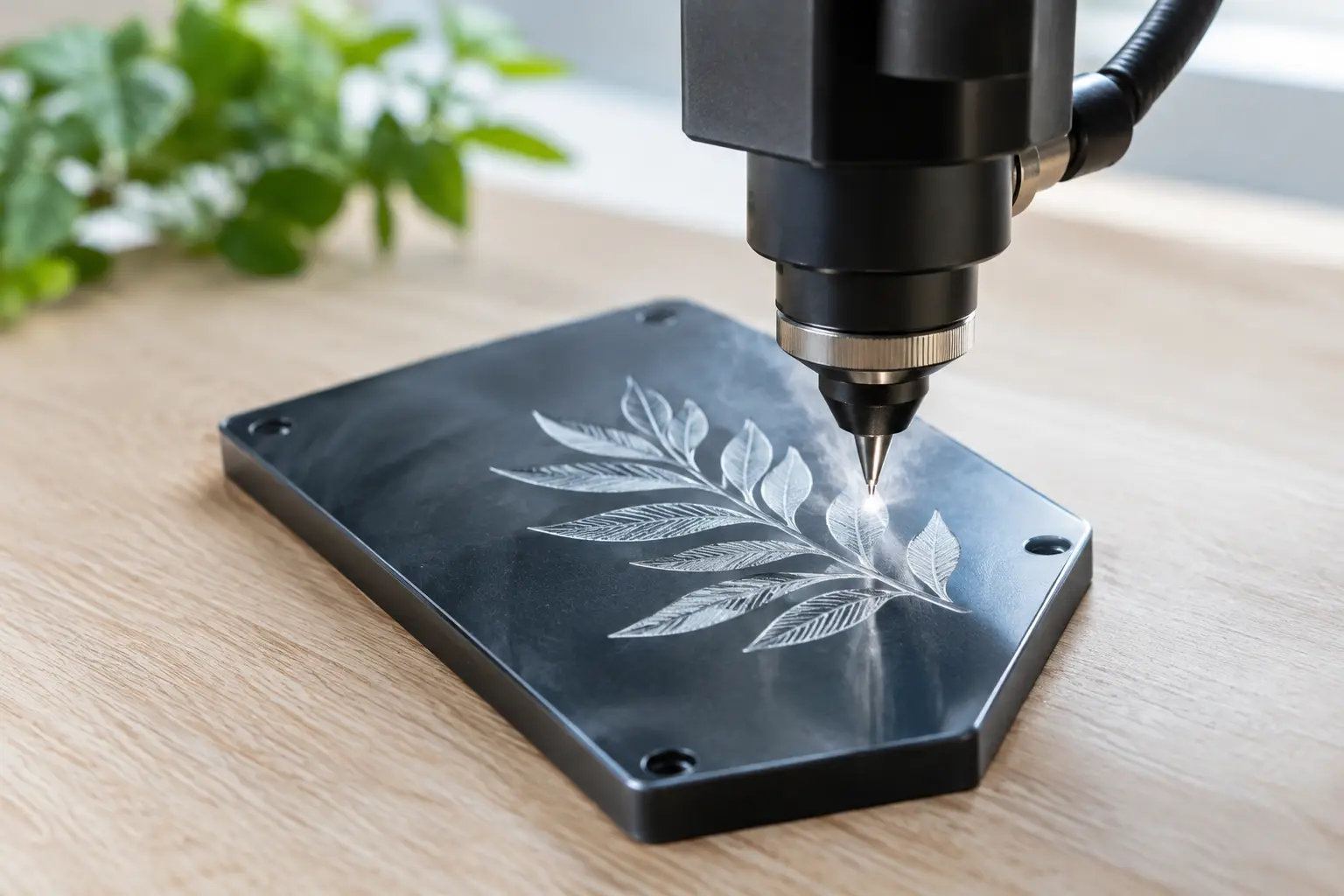
A door plate must remain legible after years of use, a trophy must display a clean name, and an equipment panel must withstand its environment. Can plastic be engraved for these purposes? Yes, provided you choose the right material and the right marking method. The word "plastic" covers a wide range of very different materials, which do not react the same way to heat or to a cutting tool.
For an order involving signage, name plates, medals, industrial labels, or personalized gifts, the question is therefore not simply whether engraving is possible. You need to determine which plastic suits the desired result, the expected lifespan, and the conditions of use.
Can plastic be engraved with a laser or CNC machine?
Both techniques can be used to engrave several types of plastic, but they do not produce the same result. Laser engraving removes or transforms the surface very precisely using a concentrated beam. It is particularly well suited for fine text, detailed logos, serial numbers, and small personalized runs. Depending on the material, it creates a light, dark, or frosted contrast.
CNC engraving relies instead on a router bit that physically removes a layer of material. It is a highly effective solution for engravable multi-layer plastics, particularly Lamicoid-type sheets. The top layer is machined away to reveal a contrasting colour underneath. This technique is commonly used for directional signage, room identification, control panels, and durable labels.
The choice depends on the object. A complex logo on a small acrylic plate may be very well suited to laser engraving. Interior signage or a technical plate requiring consistent contrast and precise depth may be better served by CNC. For some projects, the material and its finish naturally dictate the method.
The plastics best suited for engraving
Acrylic: clean, elegant, and versatile
Acrylic is one of the most popular materials for laser engraving. Cast acrylic typically produces a very clean frosted white mark that stands out clearly on plates, trophies, displays, and recognition items. Extruded acrylic can also be used, but its behaviour is more variable and the result may be less white or less uniform.
This material offers an attractive presentation for corporate awards, commemorative plaques, table numbers, and decorative panels. That said, its use should be considered realistically: acrylic can scratch or crack under significant impact. For a plate subject to heavy handling, the choice of thickness, mounting, and placement matters just as much as the engraving itself.
Two-layer plastic and Lamicoid: designed for identification
Two-layer plastics are manufactured specifically to be engraved. A thin coloured layer covers a second contrasting colour beneath it. By removing the top layer, the engraving clearly reveals the base colour. Black on white, white on black, red on white, gold on black, or silver on black: these combinations make text easy to read at a distance and support an organization's visual identity.
It is often the most straightforward choice for desk plates, doors, lockers, equipment, electrical panels, directories, and municipal or school signage. Options are available for indoor, outdoor, industrial environments, or applications requiring increased UV resistance. A material intended for indoor use should not be used on an outdoor sign without verification, even if its appearance is perfectly suitable at first.
ABS and Engineering Plastics: Useful, but Worth Validating
Some ABS and engineering plastics can be marked or engraved, but their compatibility depends on their formulation and finish. The same family of plastic can contain pigments, fillers, or coatings that completely change how it reacts to the laser. A surface may melt slightly, brown, produce little contrast, or present less precise edges than expected.
For equipment plates, components, identifiers, or functional parts, testing on the actual material remains the best practice. It allows you to validate legibility, depth, edge cleanliness, and marking durability before launching a full run.
Polycarbonate, Polyethylene, and Other Materials
Polycarbonate can sometimes be marked, but it may yellow or produce a less clean result than acrylic. Polyethylene and polypropylene, often used for containers or moulded parts, are more difficult to engrave with lasting contrast. Their low surface energy and heat behaviour can sometimes limit the visual quality achieved.
This does not mean they are unusable. Depending on the application, an engraved plate affixed to the part, specialized printing, or another marking process may be more appropriate. The right choice targets the final result, not just the technical possibility of making a mark on a surface.
Plastics to Avoid with Laser Engraving
Not all plastics should go under a laser. PVC and vinyl are among the materials to exclude from laser engraving, as they can release corrosive and hazardous fumes. These fumes can also damage the equipment. The presence of chlorine, unknown coatings, additives, or adhesives should be verified before any production.
Recycled plastics, already manufactured promotional items, and certain moulded parts also require particular attention. Their composition is not always known, even when their appearance suggests a common material. A recycling symbol can provide an indication, but it does not replace confirmation of the material.
For an item supplied by a customer — a bottle, a case, an accessory, or a collectible — it is preferable to identify the material, the type of coating, and the replacement value before engraving. Personalizing a one-of-a-kind item is not handled the same way as a run of new plates.
Choosing the Finish Based on Use
A successful engraving is judged as much by its readability as by its precision. A very thin font may look refined on screen but lose its impact on a small plaque or in a poorly lit environment. Contact information, room names, equipment numbers, and safety instructions must be sized for real-world use.
Contrast is equally important. On two-layer plastic, the background colour must stand out clearly from the surface layer. On clear acrylic, engraved text can look very elegant but may be less visible against a busy background. In some cases, a coloured acrylic, mounting on a contrasting background, or a two-layer plaque will produce a better result.
For organizations, consistency is also worth considering. A series of office plaques, league medals, or building labels gains in professionalism when fonts, colours, formats, and mounting methods remain consistent. Personalization can vary from one piece to another without compromising that cohesion.
Information to prepare before production
A clear request speeds up the selection of the right plastic and avoids rework. It is helpful to specify indoor or outdoor use, desired dimensions, number of units, exact text, colours, and required date. For a logo, a vector file is ideal, as it preserves sharp outlines at any size.
Mounting details are also worth defining from the outset: mounting holes, adhesive backing, rounded corners, plaque format, thickness, or special cutouts. A door plaque, a trophy plate, and a machine label may require similar materials while having very different mounting requirements.
When a project includes several products — for example trophies, medals, name plates, and signage for an event — grouping the needs together makes it easier to align visuals and information. It is also a simpler way to verify names, dates, and logo versions before production.
A material chosen to last
Plastic engraving is a reliable solution when it is planned with the material, process, and end use in mind. For a Lamicoid plaque, an acrylic sign, equipment identification, or custom recognition, a sample or material validation can prevent many compromises.
At Mr. Trophy, the goal is to guide every project toward an engraving, cutting, or signage solution suited to the product and its environment. A good starting point is to prepare your text, logo, quantities, and timeline: these elements make it possible to choose a finish that will remain clear and professional long after installation or award presentation.
You may also like

Install Accessible Signage Without Errors
Installing accessible signage requires more than putting up signs: placement, contrast, raised elements and mounting ensure useful landmarks for everyone.
Trophies, Medals and Engraved Plaques in Léry, Quebec: Everything You Need to Know About Mr Trophée
Discover Mr Trophée, the Léry, Quebec workshop specializing in custom trophies, medals and plaques using laser engraving and colour printing. Local, friendly service at the best guaranteed price in Canada.

End-of-Season Minor Hockey Trophies: A Guide to Rewarding Your Players
Association, coach or volunteer parent: here is how to choose trophies, award categories and engraved text for a successful minor hockey end-of-season banquet.