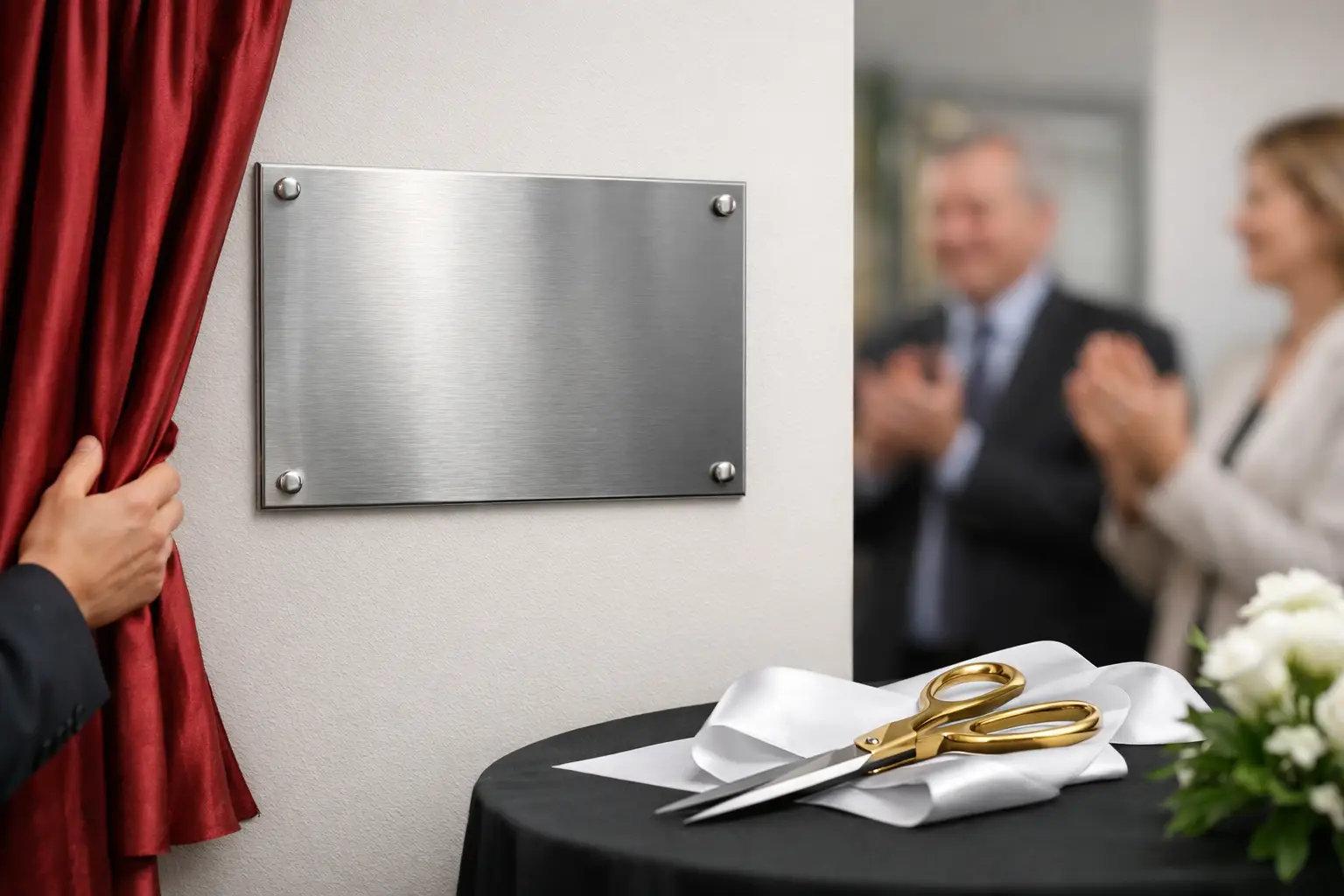
A plaque unveiled in front of a new building, a park, or a municipal facility stays in place long after the speeches and photos. Choosing from the best plaques for an inauguration isn't simply a matter of selecting an attractive finish: you need to consider the location, legibility, mounting method, and expected lifespan. For a school, a business, a municipality, or an organization, the plaque must convey the event's message accurately and withstand its environment.
Define the plaque's purpose before choosing a material
An inauguration can mark the opening of a building, the renovation of a public space, the launch of a program, a partner's donation, or a tribute to an individual. The content and format of the plaque will vary depending on this intent.
An institutional plaque installed at the entrance of a community centre must remain legible from a distance and complement the architecture. A commemorative plaque dedicated to a donor or a former leader may call for a more detailed presentation and a more personal text. For a project funded by multiple partners, you'll also need to account for the space required by logos, official names, and any required credits.
Before production, gather the final version of the text, names with their verified spelling, dates, titles, and vector logos where available. This step prevents last-minute corrections, especially when a ceremony follows a tight municipal, academic, or corporate schedule.
The best plaques for an inauguration based on location
The right material depends first and foremost on where the plaque will be installed. An indoor plaque and an outdoor plaque are not subject to the same constraints in terms of light, moisture, cleaning, and temperature fluctuations.
Bronze and cast aluminum for lasting installations
Cast bronze remains the benchmark for official inaugurations and permanent tributes. Its relief adds depth to letters and emblems, while its patina evolves over time. It is particularly well suited to facades, monuments, memorial gardens, and municipal projects. It is a durable and prestigious choice, though its cost and production time can be higher than those of a standard engraved plaque.
Cast aluminum also offers an institutional presence, with a lighter weight. It can be a relevant option for large formats or when the mounting structure has a limited load capacity. In both cases, the raised relief makes the text easier to read and maintains an official character, even when the plaque includes multiple logos.
Stainless steel and engraved aluminum for a contemporary look
Stainless steel suits modern buildings, healthcare facilities, commercial spaces, and high-traffic areas. Its clean appearance works well with laser or CNC engraving, black infill, precise cutouts, or exposed mounting screws. It holds up well under heavy use, provided you choose an appropriate finish and ensure sufficient contrast in the text.
Anodized aluminum is a lightweight, clean and versatile solution. It can be used for identification plaques, office dedications, entrance panels or projects requiring multiple copies. Its colours and finishes allow the plaque to match a visual identity, but a highly exposed installation warrants validation of the marking process and surface protection.
Acrylic, wood and glass for indoor dedications
In a reception hall, boardroom, school or cultural space, acrylic offers a contemporary look. Transparent, frosted, black, white or coloured, it lends itself to layering, contrasting lettering and decorative standoffs. It is well suited to a dedication that prioritizes interior design over weather resistance.
Engraved wood brings a warm feel to a pavilion, heritage hall, community organization or environmental project. Its finish must, however, be chosen carefully if the plaque is installed near an entrance or in a humid environment. Engraved glass, for its part, creates an elegant effect for donor recognition or the opening of a head office. It requires a protected installation and more attentive upkeep than a metal plaque.
Fitting the message on the plaque without overcrowding it
A dedication plaque is not an annual report. It must be readable at a glance, often while standing and sometimes from several metres away. The date, the project name and the responsible organization generally form the core of the message. Partners, elected officials, committee members or donors can then be added according to the project's requirements.
To maintain a clear hierarchy, give the largest character size to the name of the installation or the reason for the dedication. Secondary names, titles and funding credits can be more understated. A logo must be sharp, but it should not take up the entire surface at the expense of the text.
Contrast is critical. Dark engraving on light metal, light lettering on a black background or deep engraving on bronze all make reading easier. Very thin fonts, long quotations and low contrast may appear elegant in a mockup, but can become difficult to read on site. A good visual should be reviewed at actual size before final approval.
Planning the format, mounting and installation
The size must reflect the volume of information and the reading distance. A small plaque may be sufficient for a room or office, while a public building, sports facility or outdoor installation often calls for a more visible format. Enlarging the plaque does not solve everything: adequate margins and an open layout matter just as much as the available surface area.
The mounting method must be decided at the design stage. A plaque can be installed with decorative screws, standoffs, studs, industrial adhesive or on a freestanding support. For a wall of brick, stone, concrete, glass or wood, the anchors and installation method will differ. A heavy plaque installed outdoors requires a reliable support and hardware compatible with the substrate.
Site conditions also need to be anticipated. A façade exposed to direct sunlight can cause glare. A plaque installed close to the ground will be more susceptible to impacts, de-icing salt, and splashing. In a high-traffic corridor, corners, standoffs, and projection height all deserve careful attention. These technical details often determine how well the project holds up in appearance over the years.
Designing a plaque that reflects the organization's identity
An inauguration is also a moment of visibility. The plaque can incorporate the organization's colours, logo, and visual identity without becoming an advertisement. A municipality may favour its coat of arms and institutional typography. A business may integrate its logo with a metallic or printed finish. A school or sports association may pair the plaque with signage, trophies, or recognition items presented at the event.
When several elements need to be produced for the same ceremony, working with a specialist in engraving, signage, and graphic design simplifies the entire process. Consistency in logos, colours, and text can then be maintained across the main plaque, directional panels, door plates, and ceremonial gifts.
At Mr Trophée, laser engraving, CNC engraving, screen printing, and graphic design processes allow production to be tailored to the material, the visual, and the installation context. This approach is particularly useful when a project calls for both a durable plaque and personalized complementary elements.
Ordering in the right sequence to avoid last-minute surprises
Content should be approved before the ceremony date is announced too broadly. Changes to names, titles, or logos are common in group projects and can delay production. Be sure to also account for the time required for fabrication, visual proof approval, installation, and coordination with building or site managers.
For a complex exterior plaque, request a layout proof showing the dimensions, colours, finish, any raised elements, and mounting points. Also confirm who will be responsible for installation. A perfectly crafted plaque can lose its impact if it is mounted crooked, too high, in a shadowed area, or in front of an obstacle.
The best choice is always the one that suits the actual use of the space and makes the message immediately clear. By approving the text, material, and installation method early on, your plaque will proudly stand as part of the project's story long after inauguration day.
You may also like
Aluminum and brass plaques for your projects
Custom aluminum and brass plaques: Choose the right metal, engraving, and finish for durable, clear, professional, and reliable signage.
Retirement Gifts: Engraved Plaques and Trophies to Honour a Career
A retirement deserves a keepsake worthy of a whole career. Here is how to choose, word and order an engraved plaque or trophy that will truly touch the person being honoured.
Plaques for Building Dedications and Donor Walls: Specifying Text, Size, and Mounting
Lock plate size, line breaks, bilingual order and mounting hardware before your dedication plaque or donor wall goes to production.