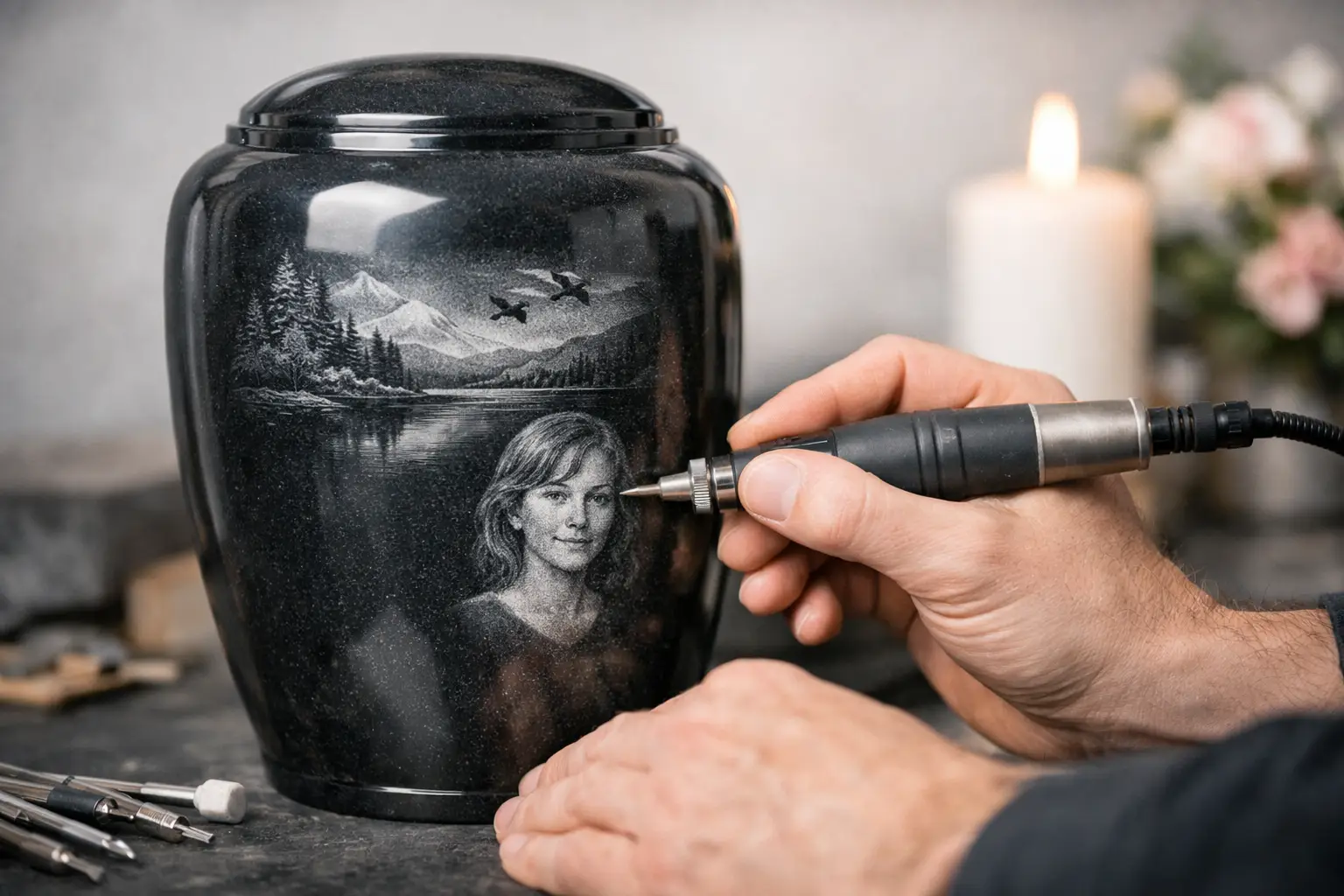
When an urn is chosen, a few words are often enough to give it an intimate dimension: a name, dates, a quote, or a symbol. Funeral urn engraving transforms this object of remembrance into a personal tribute, provided the material, available space, and the family's wishes are respected. The right choice isn't about inscribing as much text as possible, but about creating a marking that is legible, lasting, and fitting.
Funeral urn engraving: choosing what should remain
A cremation urn may be kept at home, placed in a columbarium, laid in a burial site, or shared among several loved ones in the form of keepsake urns. Its intended use directly influences the choice of engraving. An inscription meant to be seen every day has different requirements than a discreet marking on a commemorative plaque or an urn placed in a niche.
The most common content includes the person's first and last name, their dates of birth and death, and a short phrase. Some loved ones prefer to add a nickname, a family relationship, a phrase evoking a passion, or a symbolic motif: a leaf, a flower, a fingerprint, a musical note, a cross, or a religious emblem. For a family, an association logo, a military insignia, or an image may also be meaningful, provided the visual is clear enough to be reproduced.
Brevity is generally a strength. On a small surface, a long phrase requires reducing the character size and can weaken legibility. It is better to select wording that retains its impact over time. For instance, initials, dates, and a few personal words can be more eloquent than a full text that is difficult to read.
Before confirming your order, systematically verify the spelling of names, the order of dates, accents, hyphens, and punctuation. In this context, a typing error is not a minor production detail. A proper personalization process includes a clear proof, reviewed and approved before the engraving is carried out.
The urn's material determines the technique
Not all urns respond the same way to personalization. Metal, wood, ceramic, glass, stone, and certain composite materials each require different settings, tools, and methods. The final quality depends as much on the technique as on the chosen text.
On a metal urn, laser engraving can produce a precise marking, particularly for fine lettering, dates, and detailed motifs. Depending on the alloy and its finish, however, the contrast may remain subtle. An engraved plate, affixed to or integrated into the urn, can then sometimes be a better solution. It allows for a material and finish specifically designed to make the inscription stand out.
Wood offers a warm and natural presence. Laser or CNC engraving can bring out the grain, but the result varies depending on the wood species, tone, varnish, and density. Characters that are too fine may be lost on a heavily grained or dark wood. A simple typeface and an open layout generally produce a more consistent result.
Ceramics and glass require extra care. These materials can be fragile, curved, or coated with a glaze. The engraving must be assessed based on the actual shape of the object to avoid an uneven result or the risk of damage. In some cases, a matching commemorative plaque, rather than direct work on the urn, better preserves the object.
CNC engraving is particularly relevant when a project calls for a deeper mark on certain metals, technical plastics, or plaques. Laser engraving suits many precise applications and complex designs. There is no universally superior technique: the choice depends on the urn, the artwork, the level of contrast desired, and where it will be kept.
Preparing a legible and personal inscription
Typography should not overshadow the message. Highly decorative fonts may work for a short word, but they become harder to read for a full name or dates. A clean font with well-spaced lettering remains a safe choice for a funeral urn.
Layout deserves the same attention. On a vertical urn, the information can be arranged in three lines: the name, the dates, then the message. On a rounded urn, the truly visible area must be taken into account, and text should not be placed too close to the edges. A straight-on photo is not always enough: dimensions, curvature, and closure elements must also be considered.
What message to inscribe?
The chosen wording should reflect the personality of the deceased and the beliefs of their loved ones. Some families opt for a traditional phrase, such as "Forever in our hearts." Others prefer something more personal: a frequently used expression, a royalty-free verse, or a reference to a trade, a sport, or a community involvement.
When text is borrowed from a contemporary work, it is best to keep it to a short phrase or to request an original text. This avoids copyright complications and ensures the inscription remains fully personal.
Adding an image or symbol
A symbol can add a visual presence without cluttering the urn. To engrave cleanly, the file must be sharp, high-contrast, and simple enough. A silhouette, a pictogram, or a vector drawing generally produces better results than a dark, blurry, or detail-heavy image.
Portraits may be achievable on certain surfaces, but they require a quality photo and a compatible material. The result is rarely identical to a printed photograph: it relies on engraved contrasts. A mock-up makes it possible to assess whether the level of detail will remain recognizable at the intended size.
Planning for a plaque when space is limited
A personalized memorial plaque can complement an urn or offer a solution when the material is not suited to direct engraving. It can be produced in various materials, with a clean finish, a detailed border, or appropriate hardware. This option also works well for identifying a box, a monument, a niche, or a commemorative space.
Careful production starts with accurate information
To receive an accurate quote, it helps to provide concrete information from the start: the material of the urn, its dimensions, a photo of the surface to be engraved, the final text, the desired symbol, and the intended timeline. If the urn has already been purchased, it is also important to mention any relief details, painted areas, closures, and any visible fragility.
A company specializing in engraving can then recommend the most appropriate marking method, character size, and placement. At Mr Trophée, laser engraving, CNC engraving, and graphic design capabilities make it possible to explore personalization projects on objects and plaques, taking into account the specific constraints of each material.
The timeline should be discussed openly, especially when a ceremony, burial, or columbarium placement is scheduled. Creating a proof, getting family approval, and completing production all take time. An urgent request can sometimes be accommodated, but it should never come at the cost of proofreading or a proper technical assessment of the material.
Respecting the Object and the Family's Decisions
An urn may bring together the expectations of several people. One person may prefer a very simple inscription, while another wants to include a phrase, an image, or a cultural reference. In such cases, a proof becomes a useful decision-making tool: it makes proportions visible and helps find a balance before any irreversible work is done.
It is also important to check the rules of the place of deposit. Some columbariums or cemeteries require a specific format, plaque material, lettering size, or particular information. For an urn intended to remain at home, these rules do not apply, but resistance to light, handling, and cleaning should still be considered.
A successful memorial engraving does not aim to fill a surface. It gives the name, the dates, and the memory the space to speak with quiet dignity. Taking the time to choose the right text, the right material, and the right technique allows the object to carry a memory that will remain clear, even years later.
You may also like
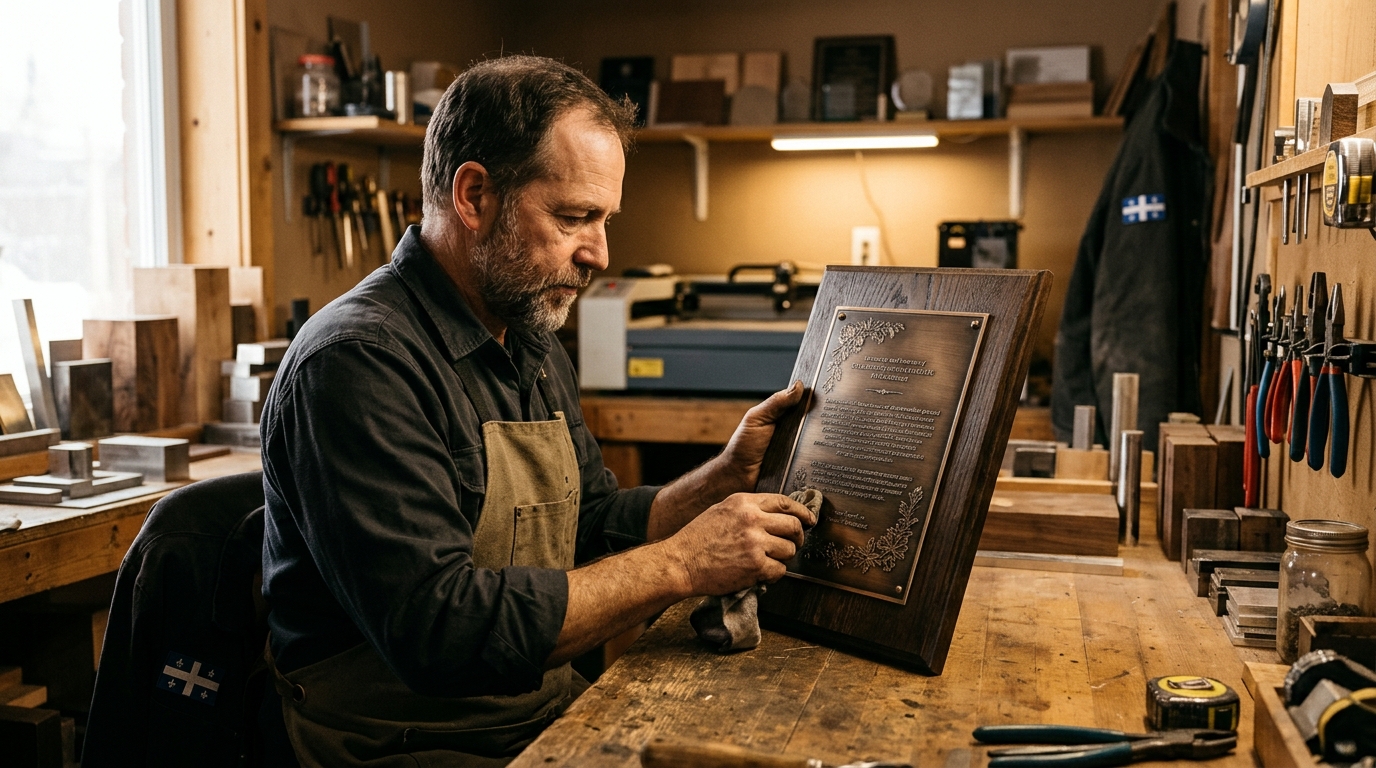
Memorial Plaques: How to Pay Tribute with Care and Durability
A tribute to a loved one, a volunteer or a place: here is how to choose the message, material and mounting for a memorial plaque that will stand the test of time.
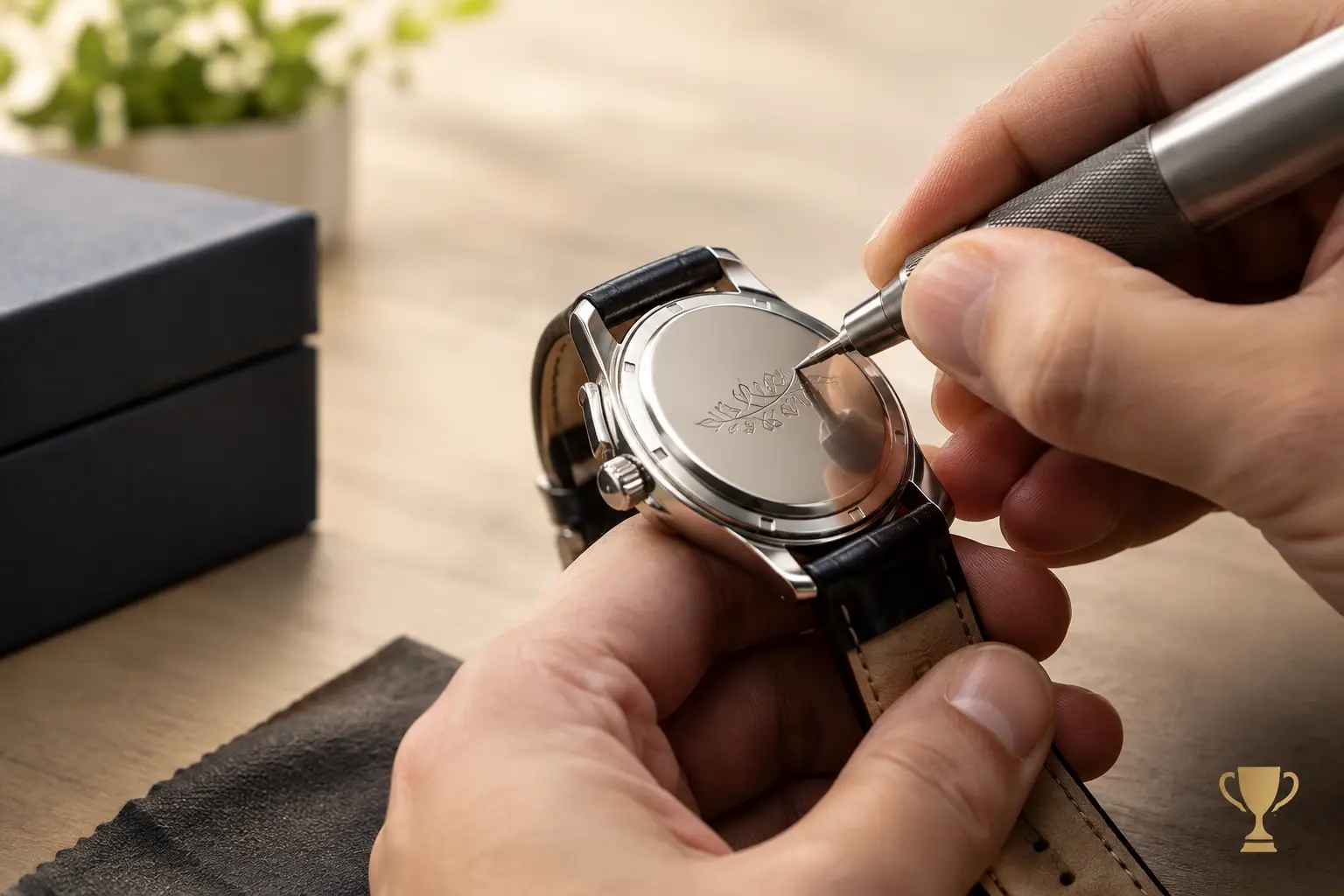
Watch Engraving: Options and Advice
Having a watch engraved requires choosing the right placement, material, and message. Tips for a durable, precise, and uniquely personal result.
Case Study: Engraving 500 Glasses and Bottles for a Gala
500 engraved glasses and bottles for a gala: the material, rotation, and pacing decisions that made the volume manageable.