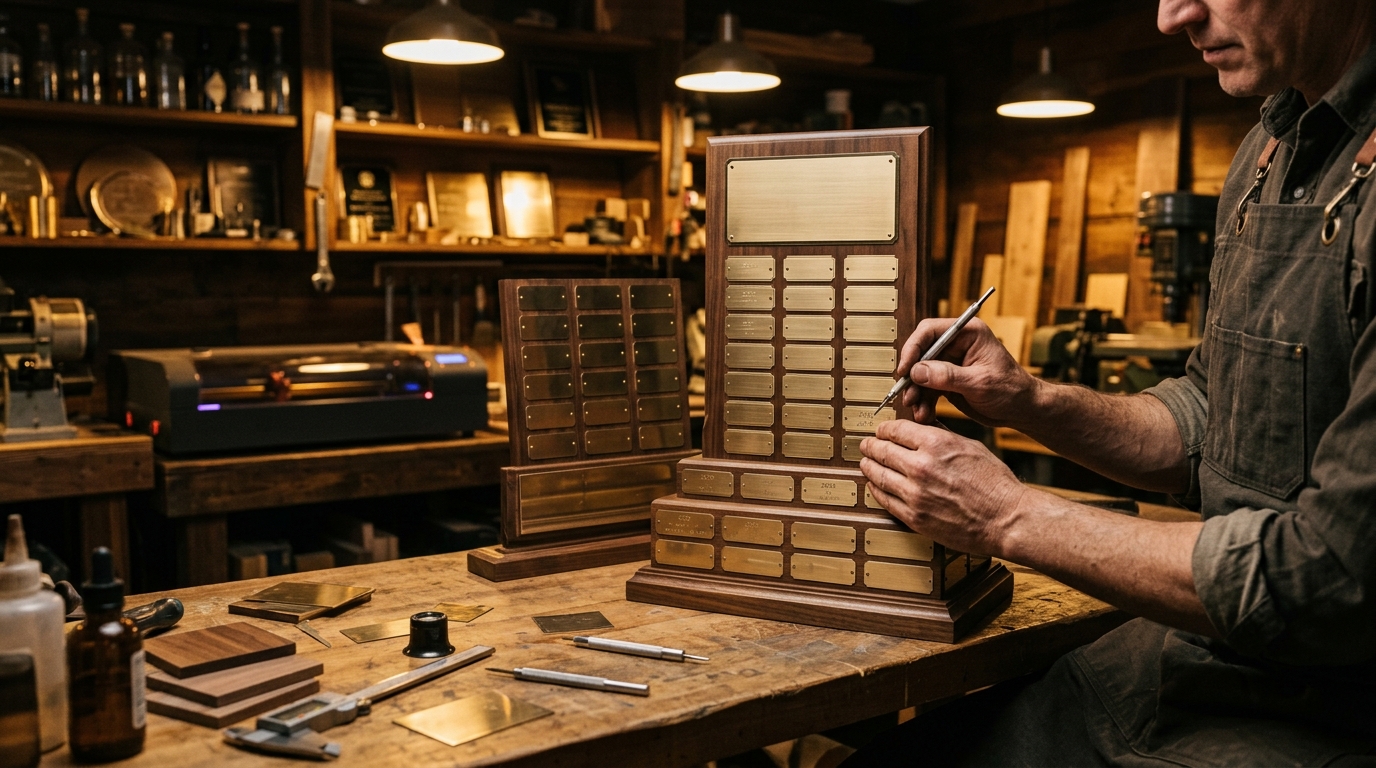
A perpetual trophy is not a static object. It lives to the rhythm of each edition, each winner and each new entry. Yet everything is often decided with the very first order. If the engraving area is too small, if the material doesn't stand up well to re-engraving or if the marking is irreversible, year three can become a real headache. Trophy engraving can't be improvised: it has to be planned like a long-term investment.
This professional guide shows you how to anticipate every choice. We'll start by explaining why a perpetual trophy needs to be planned from the first order. Next, we'll go over step 1, calculating the engraving area you'll need for the coming years. Then we'll cover step 2, choosing a material that's compatible with re-engraving, and step 3, telling marking methods apart and understanding how reversible they are. We'll also compare engraving on metal, glass, crystal and acrylic, without forgetting the third-year problem. Finally, a practical checklist and a conclusion will help you order a trophy that stays legible and elegant, even after several promotions.
Why a perpetual trophy needs to be planned from the first order
A perpetual trophy is a piece that's kept from one edition to the next: each year, the winner's name is added rather than buying a brand-new trophy. This choice immediately involves three decisions: the available engraving area, the material of the piece and the marking method used.
These decisions are locked in with the first order. An underestimated area, a material that deteriorates with each pass or non-reversible marking dooms the trophy before the third year even arrives: there isn't enough clean space left to inscribe a legible name. After the fact, you can neither thicken the piece nor erase a deep engraving without costly polishing.
The Quebec market offers a wide menu: acrylic, wood, crystal, glass, metal, plastic and custom pieces, which can be personalized by engraving or printing. The marking area also varies depending on the equipment, with some laser tables offering, for example, 610 x 305 mm.
This applies to sports leagues, annual tournaments, municipalities, businesses presenting a recognition award and community organizations.
Important note: the criteria presented here come from workshop experience and not from an official standard. No regulatory body governs perpetual trophies.
What follows details each decision, in the order in which it should be made.
Step 1: Calculate the engraving area you'll need for the coming years
In practical terms, the first decision concerns the area. Estimate the trophy's useful lifespan, whether 5, 10 or 20 years, before even choosing the model. A league that presents an award every year for 20 years doesn't have the same needs as a tournament planned for 5 editions. That duration dictates the area to set aside.
Estimate a height and a width per line of text based on the chosen font, then multiply by the number of years and add a safety margin that your workshop can specify.
Compare this total to the actual marking areas of the engraving tables used in workshops, which vary widely by model, from 460 x 305 mm to 610 x 610 mm. Finally, check that the blank area will stay clear and undecorated, away from logos, sculpted shapes and areas that are already textured. To help you with this calculation, Our 21 services include custom advice on trophy engraving.
Step 2: Choose a material that is compatible with re-engraving
The reserved surface is only worth something if the material can withstand being engraved ten times in the same spot. Not all available materials hold up equally well to repeated re-engraving.
Solid metal and hardwood absorb repeated marking without losing material. By contrast, thin plastics, painted finishes and some composites scratch, discolour or crumble with each pass, which makes the third engraving less crisp than the first.
Next, match the material with the marking technique. Fibre laser sources explicitly include bare metals, while other technologies are better suited to plastics, wood and glass. A stainless steel trophy therefore calls for a workshop equipped accordingly, which you should confirm before buying.
Stay alert to inlays and composite pieces: the engravable layer is often thinner than it looks, and re-engraving in the same spot can cut through the decoration.
The last criterion is visual consistency. A material that yellows, scratches or dulls will make engravings that were identical at the start look uneven. Choose a base whose appearance ages little, and ask the workshop for a sample that has already been re-engraved. That leaves the question of how this material will be marked.
Step 3: Tell the marking methods apart and understand their reversibility
Once the material is settled, you still have to choose the marking method. Two families coexist in the workshop.
Laser or mechanical engraving: the beam or the tool removes or transforms the material. The mark becomes part of the base, which makes it hard to erase, but also stable over time.
Surface printing: the mark is deposited on the surface. The result is vivid and multicoloured, but the top layer can wear down, peel or fade.
This distinction determines reversibility. A name error on a surface mark is hard to hide: sanding or covering it leaves a visible trace. With an integrated engraving, the workshop can often rework the area and engrave over it.
In terms of durability, a piece that gets handled, goes outdoors or sits in a damp room holds up better with a marking that is integrated into the material.
Surface printing remains relevant for decorated bases, colour logos and accompanying panels. It is often combined with engraving on the main part of the trophy, which holds the names.
One last reflex: keep the same method and the same settings from year to year. Alternating techniques produces inscriptions with a different look on the same piece.
To see the possible finishes, browse our 21 services.
Metal engraving: the most durable choice for a perpetual trophy
If metal is among your options for trophy engraving, consider it on its own: it's the material that best stands the test of decades.
The mark is built into the base rather than applied to the surface. It won't chip or peel, and it holds up to handling, transport and even a restorative polish.
Not all metals are equal. A plated, anodized or painted surface reacts differently from solid metal when re-engraved: the colored layer can wear away before the metal does, and a second pass risks cutting through the plating. Solid metal offers a more predictable working depth.
Equipment matters too. Confirm that the shop has a fibre laser source, the only technology suited to bare metals such as steel, aluminum, stainless steel, brass or titanium. A versatile shop understands these nuances, as our 21 services show.
Then there's contrast. On a light-coloured metal, a shallow engraving fades and becomes hard to read after a few years. Ask for a test on an offcut before approving the depth.
Finally, identify the smooth area reserved for names: have it measured, ask for a simulation of ten inscriptions, and make sure that logos or decorative shapes never encroach on that space.
Glass, crystal and acrylic: the pitfalls of re-engraving
Metal aside, three materials dominate perpetual trophies, and each comes with its own constraints.
Glass and crystal offer an elegant look, sought after for recognition awards. Their weak point shows up when re-engraving: running the laser close to an area that has already been engraved can weaken the piece, a risk to discuss with the shop before any re-engraving. It's best to space out the inscriptions and entrust the piece to a shop that is skilled at trophy engraving on these materials.
Acrylic, more prone to scratches than metal, requires careful handling to keep engravings crisp, especially if the piece gets passed around.
Another pitfall: glass-base trophies and 3D glass blocks, which are popular on the market, often offer little flat surface. The decorative area takes up almost everything, leaving only a narrow space for names.
The solution is to reserve, right when you place the order, a band or panel dedicated solely to the winners, separate from the design. Also specify the marking method: without making that choice at the outset, metal or laser engraving can no longer be added cleanly. To compare the options and finishes available in the shop, see our 21 services.
The third-year problem and how to avoid it
This finding about glass and acrylic plays out predictably in the third year. The first engraving is comfortable, the second still fine, and then the third forces you to squeeze names together or mark unsuitable areas, near a logo or a curve.
The solution comes down to one document: the engraving plan. From the initial order, ask for a layout diagram that reserves the spot for each future year. This plan sets the character height, the line spacing and the position of each edition.
Next, engrave the first few years using a fixed template rather than on a case-by-case basis. The alignment stays constant, the fonts stay identical, and the piece keeps a consistent look over its entire lifespan.
A simple test before you buy: ask the shop to simulate the engraving of ten names on the model you have in mind. If the simulation becomes illegible or overflows, the model is too small. Add a margin, then confirm. These checks are worth formalizing before you place your order.
Practical checklist before ordering a perpetual trophy
Once you have the engraving plan in hand, all that's left is to lock down the details before signing the order form. Here is the list to go over with your shop.
1. Lifespan and number of editions. First decide how many years the trophy needs to last (5, 10 or 20) and how many names will be inscribed on it. This answer determines everything else.
2. Available blank area. Calculate the space needed each year and apply the safety margin agreed upon with the shop.
3. Material. Confirm that it can withstand repeated engraving. Be wary of surfaces that scratch, yellow or crumble with each new pass.
4. Marking method. Ask explicitly which one will be used and find out whether it is reversible, meaning whether a name error can be corrected or concealed.
5. Written confirmation and template. Have the quote state that the piece can accommodate future editions. Keep the layout template (file, font, size and alignment) so you can reproduce an identical engraving.
6. Shop continuity. Choose a supplier who can reuse the same template year after year. Switching suppliers often means recalculating the space and accepting a different result.
A shop experienced with perpetual trophies will validate these six points before the purchase, not after the third engraving.
Conclusion: a perpetual trophy is judged by its final year, not its first
Once the checklist is complete, these three decisions (surface, material and method), locked in at the time of purchase, determine the true value of the piece over its entire lifespan, once you add up the annual engravings and the corrections you avoided.
That is why it's best to ask for a multi-year engraving plan with your very first order. The shop can then reserve the space, set a template and confirm that every future spot will remain accessible. Reacting at the third edition, when the flat area is already full, costs more and gives an uneven result.
Work with a shop that can advise on material and method based on the intended use, and then reproduce the same engraving year after year. This continuity, as much as the quality of the laser, protects the value of the piece and the legibility of the names.
In the end, the most successful trophy is not the most spectacular one on the day you buy it. It's the one that, twenty years later, still cleanly accommodates a name, a date and a team, without anything betraying the wear of time.
You may also like
Why Employee Recognition Awards Get Abandoned After Year One
Employee recognition awards fail when they are consumable. Learn why durable, personalised awards keep recognition visible and how to fix your program.

Metal Trophy versus Resin Trophy: Which One Should You Choose?
Metal versus resin trophy: compare durability, style, weight and customization to choose the right award for your annual ceremony.
School Merit Awards: Choosing Trophies and Medals for Your End-of-Year Gala
School principals, teachers and parent committees: here is how to choose trophies, medals and plaques for a merit gala that truly recognizes every student. Our tips on categories, formats, engraving and timelines.