A sponsor logo on 300 jerseys, directional signs for a facility, promotional items for a tournament: the choice between screen printing and digital printing affects the final look as much as it does the budget, the turnaround time and the lifespan of the marking. These two methods don't address the same constraints. The right decision therefore starts with how the product will actually be used, and not only with the image to be reproduced.
For schools, municipalities, sports teams, businesses and organizations, this distinction is especially useful. A production that will be handled every day, exposed outdoors or handed out at an event calls for a technique that is compatible with its material and its volume. A highly detailed image doesn't always call for digital printing, just as a large quantity doesn't automatically justify screen printing.
Screen Printing or Digital Printing: Understanding the Difference
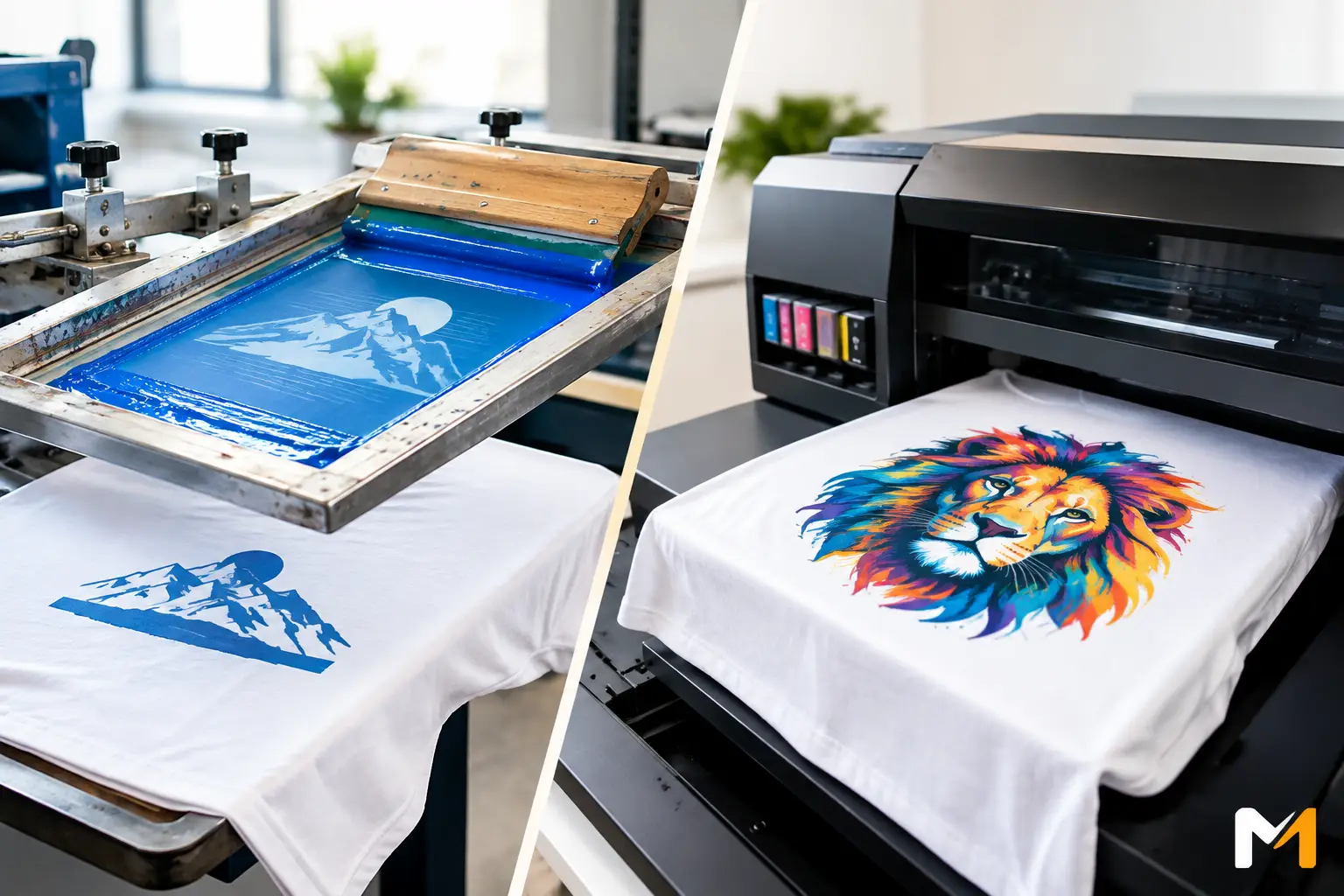
Screen printing involves pushing ink through a screen prepared for each colour in the design. The pattern is transferred onto the material one layer at a time. This method is very well suited to simple logos, bold lettering, solid colours and repeat production runs. It is commonly used for promotional apparel, bags, certain giveaway items and signage, depending on the material chosen.
Digital printing, on the other hand, reproduces the image directly from a computer file. It can produce gradients, photographs, textures and multicolour illustrations without making a separate screen for each colour. Depending on the product, it can be applied to signs, posters, stickers, promotional items or certain textiles using a suitable process.
The difference is a practical one: in screen printing, each colour is a production step; in digital printing, visual complexity often has less impact on setup. However, the way the ink behaves, the fineness of the details, the opacity on a dark background and the durability under wear all vary depending on the material. The technique therefore has to be matched to the item, not just to the graphic file.
What Screen Printing Does Especially Well
For a team uniform, a volunteer T-shirt or a series of logo bags, screen printing generally delivers solid colours and markings that are very legible from a distance. The inks can create a strong visual presence, particularly with white or a bright colour on dark fabric. Institutional logos, team numbers, event names and safety messages often find an excellent medium here.
It also becomes attractive when the same design has to be repeated on a large number of items. The initial setup takes work, since the screens have to be created and the colours adjusted. Once that setup is done, the cost per unit usually becomes more advantageous as the volume goes up. This is an important factor for leagues, annual campaigns, school activities and recurring corporate orders.
Screen printing does, however, require well-structured artwork. A vector file, defined colours and clean shapes make production easier. Photographic effects, very small details or complex gradients may be achievable in some cases, but they call for a technical assessment rather than an automatic promise.
When digital printing is the better choice
Digital printing is a good fit when the image has a lot of colours, a photo, a gradient or fine details. For a campaign that uses a full illustration, a product image or several versions of a visual, it often avoids the costs and lead times involved in creating numerous screens. It is also practical for small runs, prototypes and one-off custom needs.
It can be an effective solution for information signs, posters, stickers, displays and certain signage elements. In a municipal, school or commercial setting, it makes it possible, for example, to combine a map, pictograms, an installation photo or a detailed visual identity in a single graphic document.
Its advantage is not just the variety of colours. It also makes it easier to change a name, a date, a number or a language version from one item to the next. For an event with different sponsors, personalized awards or named gifts, this flexibility can avoid having to order several separate productions.
The material often decides before the design does
The same logo does not behave the same way on dark cotton, a technical polyester garment, a rigid sign, an identification plate or a curved object. Texture, background colour, porosity and conditions of use all influence the choice of process.
On a garment, you have to consider washing, heat, the stretch of the fabric and the print area. A team jersey that will be worn every week does not have the same requirements as a T-shirt handed out for a one-day activity. On a sign, exposure to UV rays, humidity, cleaning products and abrasion matters more. In some projects, an engraved plate, a Lamicoid product or CNC-engraved signage will offer more suitable durability than printing.
Promotional items bring their own limitations. A water bottle, a pen, a mug or a piece of glassware has a shape, a marking area and sometimes a material that determine which method is possible. A good result comes from analyzing the specific product: flat or curved surface, matte or glossy finish, quantity, base colour and intended use.
Quantity, lead time and budget: a decision tied to production
It helps to separate the setup cost from the price of each item. With screen printing, an order of a few units can seem more expensive because the screens and setup are spread over only a few products. For a large run with a one- to three-colour logo, the value for money often becomes very attractive.
Digital printing often reduces setup time, which makes it well suited to small quantities and complex visuals. That doesn't mean it is always less expensive. A large printed area, a specialty material or a particular finishing requirement can change the cost. Turnaround time also depends on product sourcing, artwork approval and the production schedule, not just on the chosen technique.
To avoid surprises, a quote request should specify the type of product, the quantity, the number of colours or the nature of the artwork, the dimensions of the decoration, the required dates and the final use. If the item needs to be delivered for an award presentation, a tournament or an official opening, it's best to share that deadline right from the start.
Preparing a file that reproduces well
A clean logo rarely causes problems, but a file pulled from a web image can limit the result. Vector files such as AI, EPS, SVG or vector PDF are ideal for logos and lettering, since they can be enlarged without losing sharpness. For a photo or a detailed digital print, a high-resolution image is required.
Official colours should also be confirmed. A colour shown on a screen can differ from the one printed on a textile or a sign. For a brand identity, providing Pantone references or known colour values helps achieve consistent reproduction. White deserves special attention: on a dark garment or a coloured surface, it may require an underbase or a suitable ink.
Very small text, extremely fine lines and tight patterns should be reviewed before production. A slight adaptation of the artwork can noticeably improve legibility without changing its identity. It's better to correct a detail at the proof stage than to discover a limitation after printing.
Choosing a consistent solution for your project
A recognition campaign may include engraved medals, volunteer apparel, banners, welcome signs and keepsakes. Bringing them together with a single specialist makes it easier to keep logos, names, colours and deadlines consistent. At M. Trophy, the assessment can take into account the decoration techniques, signage, engraving and personalization needed for the entire project.
Screen printing is often the right choice for a simple, durable design repeated over a large quantity. Digital printing is often the most flexible option for a detailed image, a small run or personalized variations. Between the two, the best choice is the one that respects the material, the intended use and the quality expected by the people who will receive or use the product.
Before launching production, prepare your artwork, indicate the date of your event and describe how the product will be used. This information makes it possible to propose a decoration that will look just as professional on presentation day as after many uses.
You may also like
UV vs. Screen Printing: Which Marking Method Should You Choose?
UV vs. screen printing: compare precision, colours, durability and costs to choose the right marking method for your trophies, items and professional signage.
Engraving or Color Printing: Which Should You Choose for Your Awards?
Laser engraving or color printing? This guide compares both techniques to help you choose the best option based on your material, budget, and occasion.
Magnetic Plaques or Stickers: Which Should You Choose?
Magnetic plates or stickers: compare hold, application, reusability and finish to choose the right signage for each professional use.