
How do you recognize an achievement without dividing the team? The question becomes very real when it's time to choose between an individual trophy, a team plaque or a medal. These objects are not mere accessories: they reflect a vision of work, contribution and cooperation. Yet rewarding only the individual within a group creates friction; rewarding only the group erases individual effort. The format you choose must therefore reflect the actual structure of the work. It also shapes your culture of recognition.
In this article, we compare these approaches and the mistakes people make in balancing them. We'll look at what a trophy, a plaque and a medal really stand for, why team recognition has declined, and how the individual and the collective fit together rather than compete. We'll offer a comparison, concrete scenarios, a decision grid and some guideposts for distinguishing symbolic recognition from compensation. The goal: to help you choose the right format for your next presentation.
Trophy, plaque, medal: what each format really stands for
A trophy is an object presented in recognition of a performance or an accomplishment, often engraved (name, date, category) and meant to be displayed. The word comes from the Greek tropaion, a monument erected on the site of a victory, as a study on the symbolism of the weapons trophy explains.
Four main formats stand out:
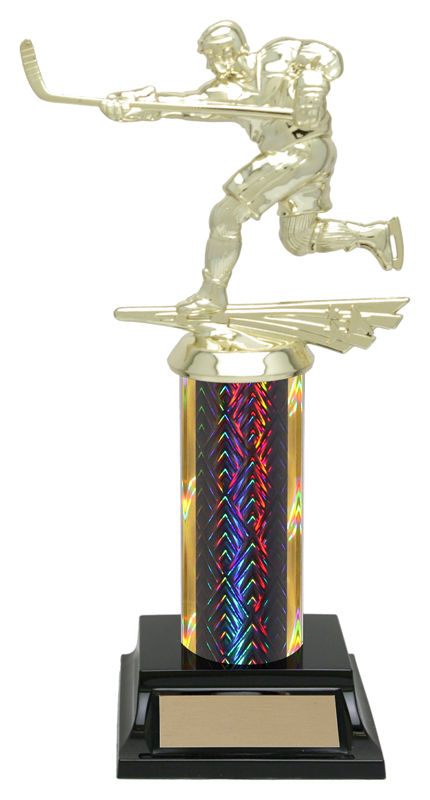
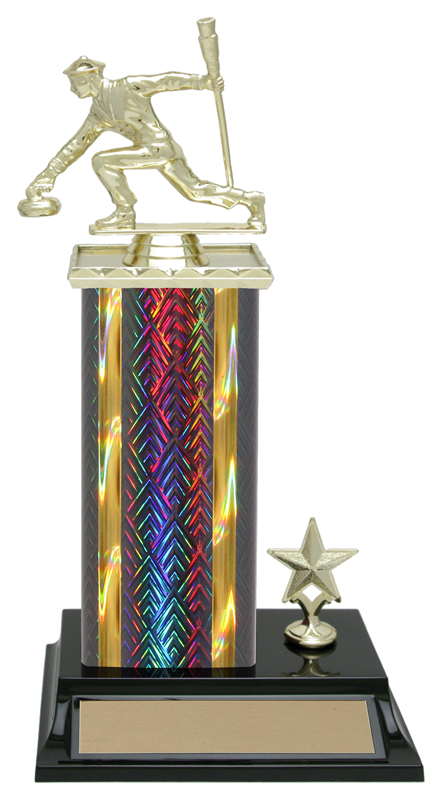
Individual trophy: one named person.
Team plaque: the name of the group and a list of its members.
Medal: given to each member.
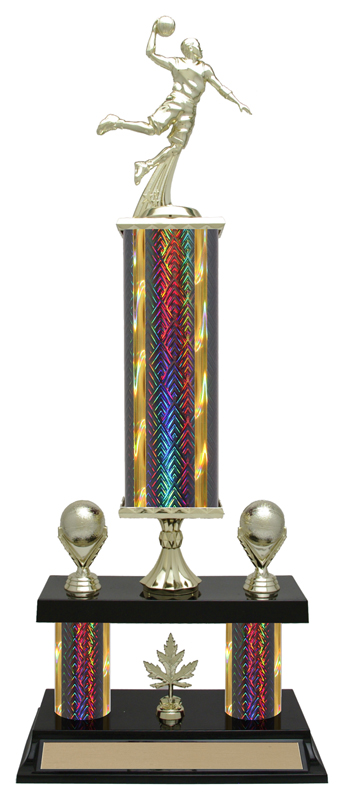
Cup: often collective, sometimes a rotating award.
Symbolic value outweighs monetary value. The object presented belongs to a different category than compensation: it makes an accomplishment, and the person who achieved it, visible.
Materials (acrylic, crystal, wood, metal) and personalization techniques (laser engraving, colour printing) make it possible to include several names, roles and a date without space constraints.
The format is not a mere aesthetic detail. It communicates who is being recognized, at what level and for what. Browse our No. 1 Catalogue of Trophies, Medals and Plaques and our 21 services to bring this recognition to life.
Why team recognition has declined in recent years
While the formats described above have evolved, team recognition has declined. On January 10, 2024, an article in Harvard Business Review France attributed this decline to two causes: remote work, which has weakened social relationships, and above all, compensation policies based on individual evaluation.
In the same article, Christophe Laval, founding president of VPHR, describes a perverse effect: rewarding a single individual when the result depends on a group creates an imbalance and fuels a sense of unfairness. The message is clear: the person who receives the award is not always the one who made the result possible.
Add to this the inflation of performance management. Jérôme Gautié (LIEPP, Sciences Po, 2023), cited by HBR France, reports that a manager must track roughly 200 indicators to steer their department. This tightening of control is experienced as an attack on autonomy and trust.
Yet the need for recognition remains. According to the Revue Gestion of HEC Montréal, managers agree that they need to show their appreciation, but many don't know how to express it. That is where the format presented becomes a concrete tool.
In 2026, the subject remains topical: Revue Gestion is devoting a feature to the theme, and the University of Ottawa continues to run an activity on individual and team recognition as part of Excellence Canada's National Standard.
Individual and Team: Two Approaches That Fit Together Rather Than Compete
Once the background is documented, the next step is choosing the right level at which to address recognition. As HBR France points out, leaders and managers don't manage only individuals: they also steer teams. A work collective is defined precisely as individuals united by shared professional standards and quality criteria, a framework that allows individual activities to flourish.
The real question, then, is not "individual or team," but "at what level is the work actually structured?" That structure should dictate the format presented, not the other way around.
The University of Ottawa, as part of Excellence Canada's National Standard, offers two directly applicable principles: recognize not only results but also effort, and discuss ideas rather than individuals. The second principle avoids personalizing criticism; the first broadens recognition beyond final performance alone.
Three perspectives should then be covered during a presentation: the individual (whether staff or faculty), the team, and then the manager. Each expects a form of recognition suited to their role.
Recognizing the team does not negate the individual; recognizing the individual does not dissolve the team. It is on this basis that comparing the two approaches makes full sense.
Comparison: Individual Recognition and Team Recognition
Work is structured on several levels: the format presented must therefore meet comparable criteria.
Criterion
Individual recognition
Team recognition
What is highlighted
One person's performance
A group's coordination
Main risk
Ignores interdependence, creates friction
Erases the person who carried the project
Typical format
Individual trophy, medal
Team plaque, cup
Duration of the effect
Strong, targeted mark of distinction
Cohesion sustained over time
Advantages of individual recognition: a precise message, direct motivation, a clear benchmark for peers, and relevant when the work is truly independent.
Advantages of team recognition: strengthens cohesion, values coordination, reduces internal rivalries, and suits cross-functional projects and sports teams.
Limitations: individual recognition alone ignores interdependence and creates friction; team recognition alone makes the person who carried the project invisible.
The recommendation, then, is to combine both levels in a single presentation, with a separate item for each, for example a team plaque and an individual trophy, rather than choosing sides.
Balancing mistakes to avoid
Combining both levels is not enough: the balance matters as much as the choice of format. Five mistakes come up regularly.
Rewarding a single individual for a team result. When success depends on several contributors, a single trophy creates friction and demotivates the others.
Presenting a plaque with no names on it. A purely collective item erases individual contributions: no one knows who did what, or why the team succeeded.
Contradicting your own message. Promoting team spirit all year, then presenting a strictly individual trophy in front of everyone, sends a mixed message.
Concentrating recognition in a single annual presentation. An item handed out once, with no ritual or context, is quickly forgotten. Yet recognition should honour effort as much as results.
Handing out meaningless medals. An identical item for everyone, with no distinction between roles, dilutes the value of the gesture and reduces recognition to a mere accessory.
The common thread in these five mistakes is the same: a format that does not match the real structure of the work loses its symbolic impact. What remains is to determine which one to favour in each situation.
Which format for which work structure?
Once the balance is corrected, the choice of format flows from the real structure of the work, not from an aesthetic preference.
Independent individual work. Sales, expertise, craftsmanship or research: an individual trophy engraved with the person's name, noting the result and the period covered, remains the fairest format.
Cross-functional project or leadership team. A team plaque listing the members and their roles, or a cup kept on the premises and visible to all, values coordination rather than a single name.
Sports team. The winning pair: a team trophy presented to the captain and a medal for each player. Both levels of recognition are covered in a single moment.
Long service or year-end. A plaque or medal with laser-engraved dates suits the occasion better than a performance trophy. More understated, it highlights sustained effort.
Municipal or community event. A commemorative plaque or a rotating trophy, with a full-colour logo print and bilingual wording when the audience is mixed.
These formats can be customized with laser engraving and colour printing. See our 21 services for the available options. Our 21 services also outline the bilingual support the workshop offers.
Decision Guide and Real-World Scenarios
Three questions are enough to decide.
1. One person or several roles? If the result depends on a single person, an individual trophy is the obvious choice. If it comes from coordination among several roles, a team plaque or cup becomes the main format.
2. Public or internal presentation? In front of peers, a displayed object such as a trophy or a plaque extends the gesture. Internally, an engraved medal or certificate is enough.
3. Result or effort? A one-time result calls for a trophy. A long-term effort, such as a process overhaul or a full season, is better recognized with a plaque or a recognition medal.
Real-world scenarios. In a business setting, a project delivered by five people is recognized with a team plaque bearing their names and roles, supplemented by an individual mention for the coordination. In sports, a championship win is celebrated with a team cup for the club and a medal for each player. In a municipal setting, a volunteer event is recognized with a medal or a plaque noting the year and the role.
These answers determine the format. What remains is to distinguish this symbolic gesture from compensation.
Symbolic Recognition: A Lever Distinct from Compensation
Once the format has been chosen based on the actual structure of the work, one clarification is necessary: the object presented is symbolic recognition, not compensation. A trophy, plaque or medal complements a salary; it does not replace it and must never serve as a disguised substitute for a refused raise. The Revue Gestion (HEC Montréal) speaks of recognition "beyond money," a distinct register.
The manager remains the key player. They are the one who names the effort, chooses the level of recognition, individual or collective, and explains why this object is being presented. Without this context, even the most beautiful piece remains silent.
To keep recognition from coming only from the top, plan a simple mechanism: peer nominations, or an internal vote at the end of a project or season. The team itself names those who helped make it succeed, which strengthens the legitimacy of the gesture.
A lasting reminder matters too. A trophy displayed at the reception desk, a medal worn at competitions or a plaque hung on the wall extends the effect of the presentation well beyond the evening itself.
A word of caution, however: the sources consulted provide no Quebec statistics linking the format presented to engagement. It is best to avoid any numerical promises and stick to design logic.
What to Remember for Your Next Presentation
Moving from logic to presentation requires one last decision: the format. Choose it based on the actual structure of the work, never on the preference of the moment or what happens to be in stock. If the result depends on coordination, the object should reflect that.
In most cases, plan for both levels: a team piece (plaque or cup) that names the group, and an individual recognition (trophy or medal) that acknowledges each person's contribution. Add names and roles to the piece using laser engraving or colour printing. An anonymous plaque erases everyone's work.
Next, establish a rhythm: highlight effort as much as results, and repeat the gesture rather than concentrating everything into a single annual evening. Recognition gains credibility when it comes back around.
To compare the available formats, check out our 21 services and browse our 21 services to see the pieces in context.
Mr Trophée, a workshop in Léry, Quebec, works with businesses, municipalities, sports teams and organizations: trophies, plaques, medals, laser engraving and colour printing, with bilingual service. 514-565-6665.
Conclusion
The recognition format is never just a logistical detail. It tells the story of how your work is structured. First, remember that each format sends a distinct message. Second, team and individual recognition complement each other: name the team, then the contributions. Personalize each piece with engraving or colour printing. Finally, establish a regular rhythm, because repeated recognition gains credibility. Avoid numerical promises and rely on design logic instead.
To take action, browse our catalogues and our past projects. Choose the format that reflects your reality, then take a concrete step at your next presentation. Mr Trophée supports you with bilingual solutions, from laser engraving to colour printing. Call 514 565 6665. A well-designed recognition piece doesn't just decorate a wall: it clearly says who contributed, how, and why it matters.
You may also like

Metal Trophy versus Resin Trophy: Which One Should You Choose?
Metal versus resin trophy: compare durability, style, weight and customization to choose the right award for your annual ceremony.

Championship or Season-Long Awards: Which Trophy Fits?
Compare championship trophies and season-long points awards: what each signals, what drives cost, and how leagues budget for both without overspending.

Perpetual Trophy: Planning Engraving Year After Year
Trophy engraving: plan the surface, material and marking so your perpetual trophy stays legible year after year. A practical guide and checklist to review before you order.