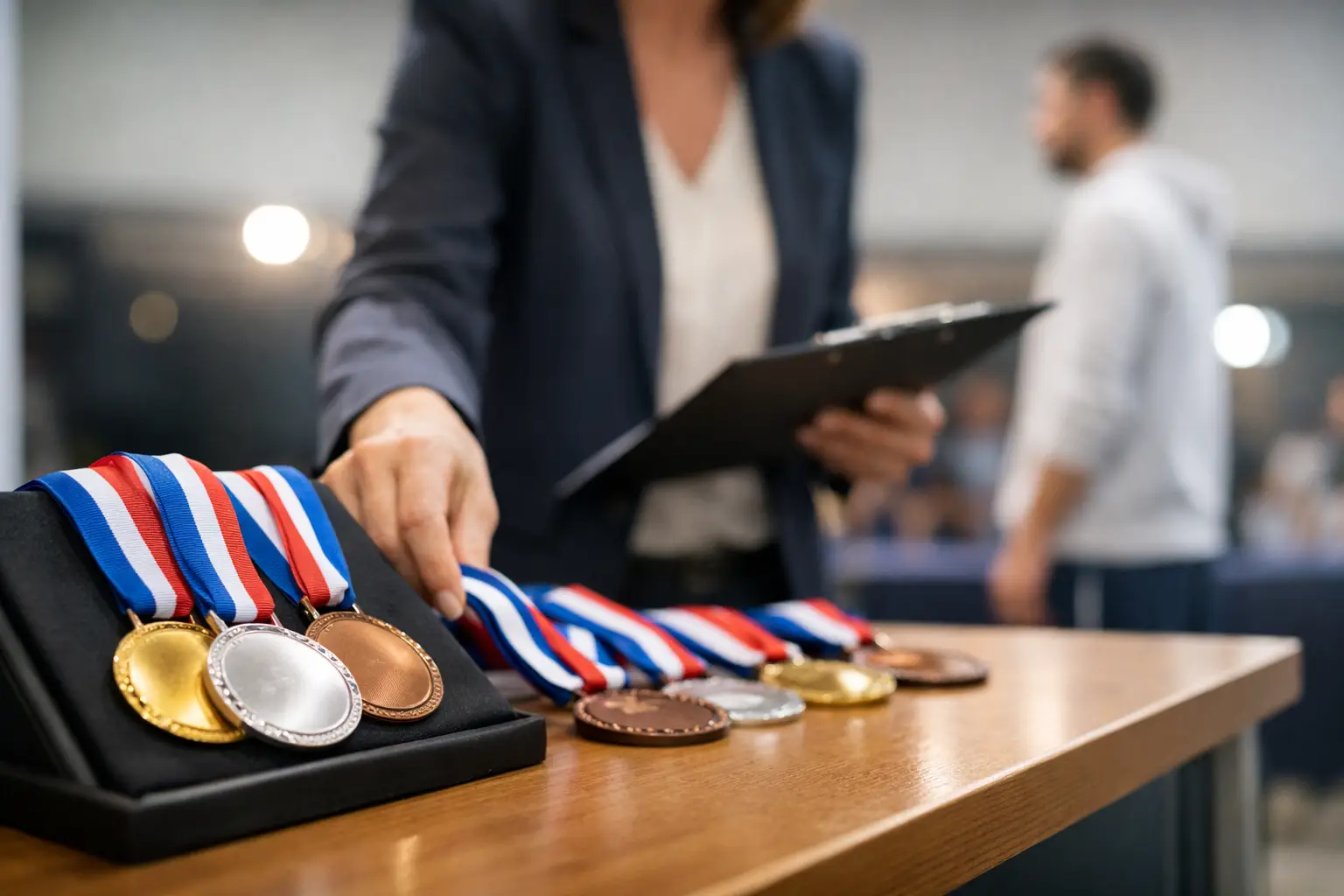
A successful presentation often comes down to details the audience never sees: the spelling of a name, the order in which recipients are called, a medal ready at the right moment, or a clear podium for the photo. Organizing a medal presentation therefore takes more than an invitation and a table full of awards. It means coordinating the recognition message, the custom products, and the flow of the ceremony so that every honouree truly feels seen.
For a sports club, a school, a business, a municipality, or an association, the medal makes an achievement visible and lasting. It can mark a performance, a volunteer commitment, the end of a season, participation in an event, or an organizational anniversary. The right choice depends as much on the context as on the budget, the number of recipients, and the production timeline.
Defining what the medal should recognize
Before choosing a model, clarify the exact reason for the presentation. A participation medal for a youth tournament sends a very different message than gold, silver, and bronze medals for a championship. In a school setting, the focus may be on effort, progress, or attendance. In a business context, a commemorative medal can mark years of service, a safety milestone, or a contribution to a major project.
This step prevents vague distinctions. If everyone receives the same medal, the wording should be inclusive and clear: "2026 Season," "Graduate," "Participant," or "Thank you for your commitment." If ranking levels differ, determine from the outset the categories, the criteria, and the number of pieces required. A list validated by the committee or event organizer greatly reduces the risk of oversights.
Format matters too. A metal medal with a ribbon is well suited to competitions and official ceremonies. An acrylic medal, an engraved plaque, or a trophy may be a better fit for professional or association-based recognition. There is no obligation to choose a single type of award: winners can receive a custom medal, while volunteers or partners receive a plaque or an engraved gift.
Planning for legible and lasting personalization
Personalization is what gives a product its value. A logo, the event name, the year, a discipline, and the recipient's name can all be incorporated depending on the available surface. That said, resist the urge to include everything. A medal is a small object: text that is too long becomes difficult to read and loses its impact.
The front typically features the main visual or the organization's emblem. The back can carry a laser engraving with the name, ranking, date, or a short inscription. For larger series, the same visual can be reproduced on every medal, with each piece then receiving its individual inscription. This approach makes quality control easier while still delivering a personal result.
Provide a clean logo file and confirm that all names are finalized before production begins. Accents, hyphens, titles, and team names deserve careful proofreading. Accurate engraving is essential, as replacing a custom medal at the last minute can affect both the schedule and the budget.
Planning the Organization of a Medal Presentation Ceremony
Placing your order should not be the last step in your preparation. Start by setting the date and time of the ceremony, then work backwards: confirming results, collecting names, creating or approving the artwork, production, delivery, quality control, and on-site preparation. The time required will vary depending on quantity, medal type, personalization, and the time of year. An end-of-season or end-of-school-year ceremony often calls for extra lead time.
Consider keeping a few unengaved or spare medals on hand where appropriate. They come in handy for last-minute category additions, urgent corrections, or presenting to someone who was absent. That said, don't rely on this small surplus to compensate for an incomplete list: named pieces must be verified one by one before the event.
Centralize all information in a single document. It should include the category, full name, team or department, distinction awarded, text to be engraved, and the order of presentation. This sheet serves the production team, the emcee, and the person presenting the medals alike. It reduces hesitation in front of the audience.
Choosing an Order That Honours Recipients
The order of presentation affects both the pace and the audience's attention. For a competition, starting with participation categories or younger age groups and finishing with the podium creates a natural progression. For a professional ceremony, grouping distinctions by team, seniority, or project helps the audience understand what is being celebrated.
Each presentation should allow the recipient a few seconds. Their name is announced, they step forward, receive their medal, shake hands if the protocol allows, then briefly pose for a photo. A presentation that moves too quickly can feel mechanical. Conversely, an overly lengthy comment for each recipient may tire the audience when there are a large number of people being recognized.
A good rule of thumb is to prepare one short line per category rather than a systematic individual speech. For example, the emcee might acknowledge the role of a volunteer team before calling the names. For major awards, a slightly more detailed introduction is warranted. The level of personalization in the remarks should therefore reflect both the number of recipients and the nature of the recognition.
Preparing the Space and Assigning Roles on the Day Of
The presentation table should be arranged in the exact order of the call-ups. Lay the medals flat, with ribbons untangled and inscriptions easy to check at a glance. If names are engraved on the back, use a small identification label or place each piece in an individual envelope. Rummaging through an open box on stage is the surest way to slow a ceremony down.
Designate at minimum one person to call out the names, one person to present the medals, and one person to arrange them in order beforehand. For larger events, add a photographer and a coordinator responsible for guiding groups. Roles should be rehearsed before the audience arrives, particularly when there are many recipients or when multiple distinctions are being presented at the same time.
The photo area deserves special attention. A clean background, the organization's logo, good lighting and an unobstructed circulation area make images more useful for families, internal networks or the event recap. Promotional apparel, banners, sponsor plaques or identification panels can complement the presentation without drawing attention away from the people being honoured.
Think about accessibility as well. Plan for easy access to the stage or presentation point, a solution for people with reduced mobility and a visible spot for accompanying guests. Inclusive recognition is not limited to engraved text: it shows in the way everyone can take part in the moment.
Handling the Unexpected Without Losing Momentum
Absences, ranking changes and delays are part of the reality of any event. Prepare a simple phrase for absent recipients and keep their medals in labelled envelopes. If a result is disputed or unconfirmed, it is better to postpone the relevant presentation than to announce uncertain information in front of the audience.
Keep a printed copy of the running order. Phones and tablets are convenient, but a paper list remains invaluable if the connection, battery or presentation app fails. Also check the microphone, name pronunciations and any music before the ceremony begins.
For organizations that hold this type of event regularly, keep the visual assets, logo files, engraving templates and the program from the previous year. This file makes future orders easier and allows the recognition program to evolve without starting from scratch. An engraving and awards specialist like Mr Trophée can also help you coordinate medals, trophies, plaques and signage elements to suit your program.
A well-chosen medal stays for a long time in a drawer, a display case or a memory box. By preparing names, engraving and the ceremony's gestures with the same care, you turn a few minutes on stage into recognition that participants will want to keep.
You may also like
Participation Medal or Victory Medal: How to Decide
A medal for everyone or only for the champions? A simple rule based on the number of participants and the level of play to settle it for your tournament.
Choosing the Right Font for Your Medal
Choose a font for your medal: adapt the typography to the space, the engraving process, and the event for a legible and lasting everyday marking.
Trophies and Medals for a Basketball or Volleyball Tournament: A Guide for Organizers
Organizing a basketball or volleyball tournament? Here is how to choose trophies, medals and individual awards without going over budget.