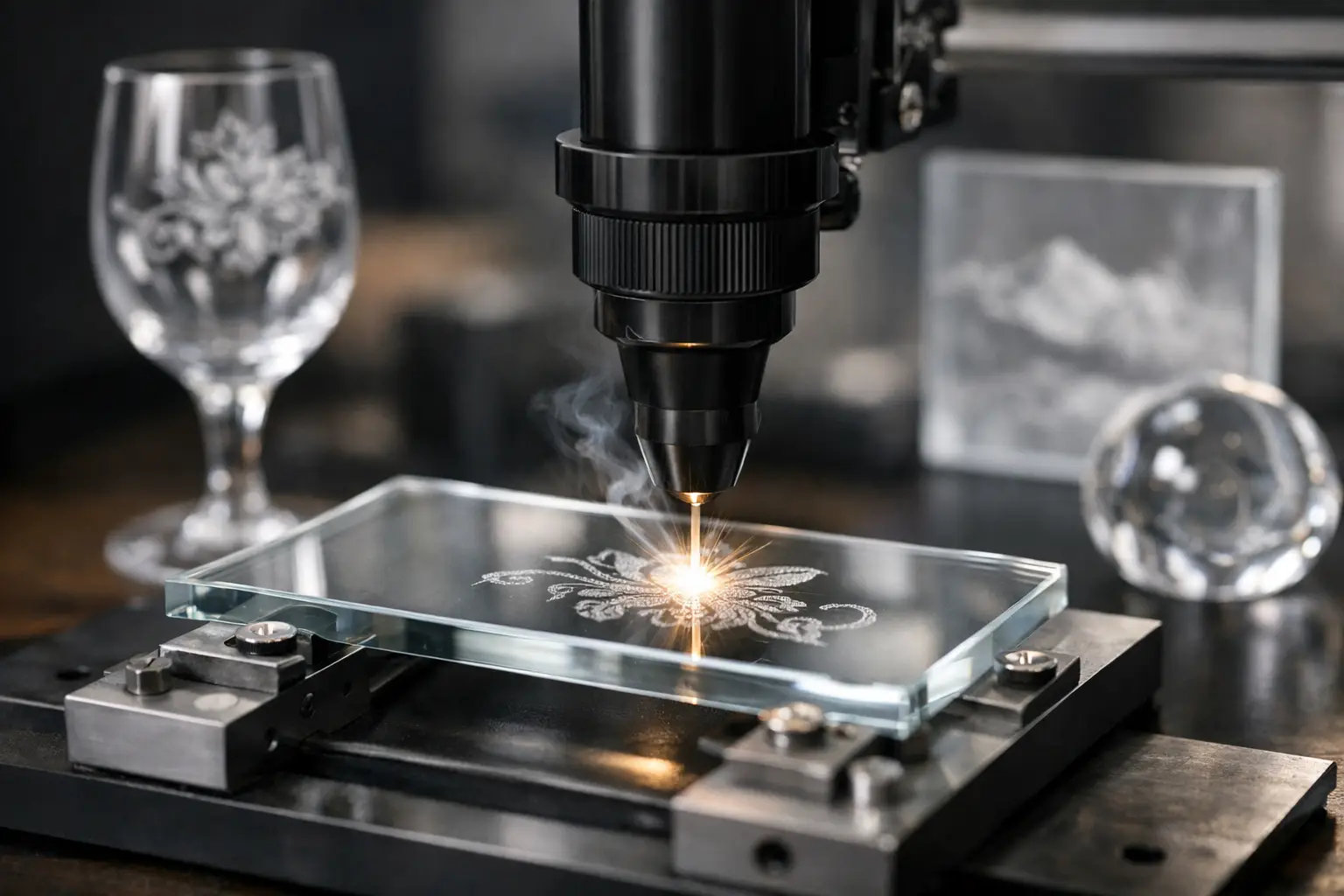
A glass trophy doesn't stand out for its shape alone. From a few steps away, it's the contrast of the marking that catches the eye: a legible name, a well-placed logo, an accurate date, and a finish that stays elegant under stage lighting or in a boardroom. Laser engraving on glass meets these requirements with precise personalization, suited equally to recognition programs, commemorative gifts, and promotional items.
For a tournament, a school gala, an employee awards ceremony, or a recognition plaque, glass delivers a clean, lasting presentation. That said, the choice of substrate, artwork, and personalization method needs to be made from the outset. The same graphic file won't produce the same result on thick crystal, a bottle, a wine glass, or a glass plaque.
What laser engraving on glass produces
Laser engraving on glass slightly alters the surface of the material. The beam creates a frosted or satin effect that contrasts with the transparency of the glass. It isn't a printed colour applied onto the object: the marking becomes part of the surface and won't fade with normal use.
This technique is particularly well suited to text, numbers, team names, dates, monograms, and sharp-lined logos. It is commonly chosen for glass or crystal trophies, honour plaques, decanters, bottles, drinking glasses, and certain corporate gifts. For an organization, it also makes consistency easier to achieve: the same visual identity can be carried across multiple award categories, from an individual distinction to an end-of-season prize.
The result is generally understated and professional. On clear glass, the engraving appears white or frosted depending on the angle and light. On dark, coloured, or frosted glass, the contrast may vary. That's why it's better to evaluate the product and the artwork together, rather than choosing the vessel on one hand and the marking on the other.
Which glass item should you choose for your project?
The right substrate depends first on the intended use. A glass plaque works well for institutional recognition, a retirement, or an appointment. Its format provides a generous engraving area to incorporate a logo, the recipient's name, a title, and a short message.
Glass and crystal trophies are particularly well suited to galas, sporting competitions, corporate events, and school ceremonies. Their weight and transparency lend a more ceremonial presence than a medal or a promotional item. They're also available in a wide range of silhouettes: column, flame, rectangle, globe, star, or sport-specific shapes.
For a personalized gift, bottles, decanters, goblets, flutes, and glasses can be a more meaningful choice. An engraved bottle to mark a company anniversary, a whisky glass to thank a volunteer board member, or a decanter to commemorate a promotion creates a functional object that retains personal significance.
The regularity of the surface also matters. A flat face often allows more flexibility when placing text and a logo. A cylindrical surface, like that of a glass or a bottle, requires positioning adapted to the curve. Patterns that are too wide, very long text, and tiny details are harder to read on such surfaces.
Glass, crystal, and client-supplied items
The word "glass" covers a wide range of qualities. Some items are thick, uniform, and designed for personalization. Others have bubbles, internal stress, a pronounced curve, or a more fragile construction. These characteristics can affect the appearance of the engraving.
Crystal can offer beautiful clarity and a satisfying weight for high-end awards, but its behaviour varies depending on its composition. Tempered glass, very thin objects, and pieces of unknown origin also require assessment before production. When a client brings in a personal item, evaluating the material and the condition of the piece helps reduce risks related to fragility or pre-existing flaws.
Preparing artwork that will stay legible
A good engraving starts with a clear visual hierarchy. The name of the person or team should be the most prominent element. Next come the award received, the event, and the date. Full text may be appropriate for a recognition plaque, but it quickly becomes difficult to read on a small glass or a flask.
Vector logos offer the best starting point, as their outlines stay clean when resized. Vector PDF, AI, EPS, or SVG files are generally easier to work with than screenshots and compressed images. An image can sometimes be used, but it must be sharp enough and have clear contrast between the areas to be engraved and those that will not be.
Thin lines deserve special attention. On a screen, a very light rule can look elegant. On glass, it may be barely visible or get lost in the details of the design. The same applies to decorative fonts, very small lettering, and logos filled with textures. Slightly simplifying the artwork often results in a cleaner engraving that holds up better visually.
For institutional orders, consistency matters as much as aesthetics. Using the same approved logo, the same award titles, and a uniform layout from one year to the next makes recognition programs easier to manage. A proof makes it possible to verify the spelling of names, accents, official titles, line breaks, and dimensions before production begins.
Limitations to know before placing an order
Laser engraving creates an elegant marking, but it does not always offer the same contrast as colour printing. If a logo needs to reproduce several brand colours or be visible from a distance, another method or material may be better suited. For directional signage, for example, acrylic, aluminum, or Lamicoid may be more appropriate depending on the location and conditions of use.
The result also depends on lighting. An engraved trophy often appears highly contrasted against a dark table or coloured background. Placed in front of a window, it may look more understated. In an awards presentation context, adding a base, choosing a thicker shape, or selecting a model with a frosted area can improve readability from a distance.
Timelines also influence decisions. An order for many awards with variable names requires a final list that has been carefully verified. For an event, it is helpful to submit the information as soon as the recipients are confirmed, without waiting until the day before the ceremony. This allows time to prepare the files, complete the necessary approvals, and produce each piece with the same level of care.
Staying Organized When Ordering Trophies or Engraved Gifts
To obtain a clear quote, it is helpful to specify the type of item needed, the quantity, the deadline, and the number of text variations. A series of fifty trophies bearing the same logo but fifty different names does not come together the same way as fifty identical items. Variations in categories, positions, and dates should also be indicated.
A structured list reduces errors. It can include the recipient's exact name, the award title, the team or department, and any special message. For bilingual organizations, both the French and English versions must also be confirmed, particularly for job titles, program names, and recognition wording.
At Mr Trophée, projects can bring together several needs around a single event: engraved trophies, medals, plaques, promotional apparel, or signage. Grouping these elements helps maintain a consistent visual identity and simplifies communication with a single personalization specialist.
Caring for an Engraved Glass Item
Laser marking requires no special products. A gentle wash, free of harsh abrasives, is generally sufficient for glasses and carafes. A plaque or trophy can be dusted with a lint-free cloth. Avoid impacts, sudden temperature changes, and storing items without protection, especially for delicate pieces or crystal awards.
For gifts intended for regular use, choosing a quality item remains essential. The engraving may be flawless, but the overall experience also depends on the thickness of the glass, the stability of the base, the feel in hand, and the product's ability to withstand its intended use.
A successful engraving does not need to be elaborate to make an impact. A well-chosen piece, a few key details, and a visual prepared for the material are all it takes to transform an object into a lasting keepsake — ready to mark an achievement, represent an organization, or commemorate an occasion that truly matters.
You may also like
Preparing Your Logo for Laser Engraving and Printing: File Formats and Best Practices
A good file is half of a great trophy. Here are the formats, resolutions and tips to know so your logo looks sharp on your plaques, trophies and medals.
Laser engravers for awards, plaques, and objects
Choosing laser engravers to personalize trophies, plaques, gifts, and signage with a precise, durable finish tailored to each material.
Watch Engraving: Options and Advice
Having a watch engraved requires choosing the right placement, material, and message. Tips for a durable, precise, and uniquely personal result.