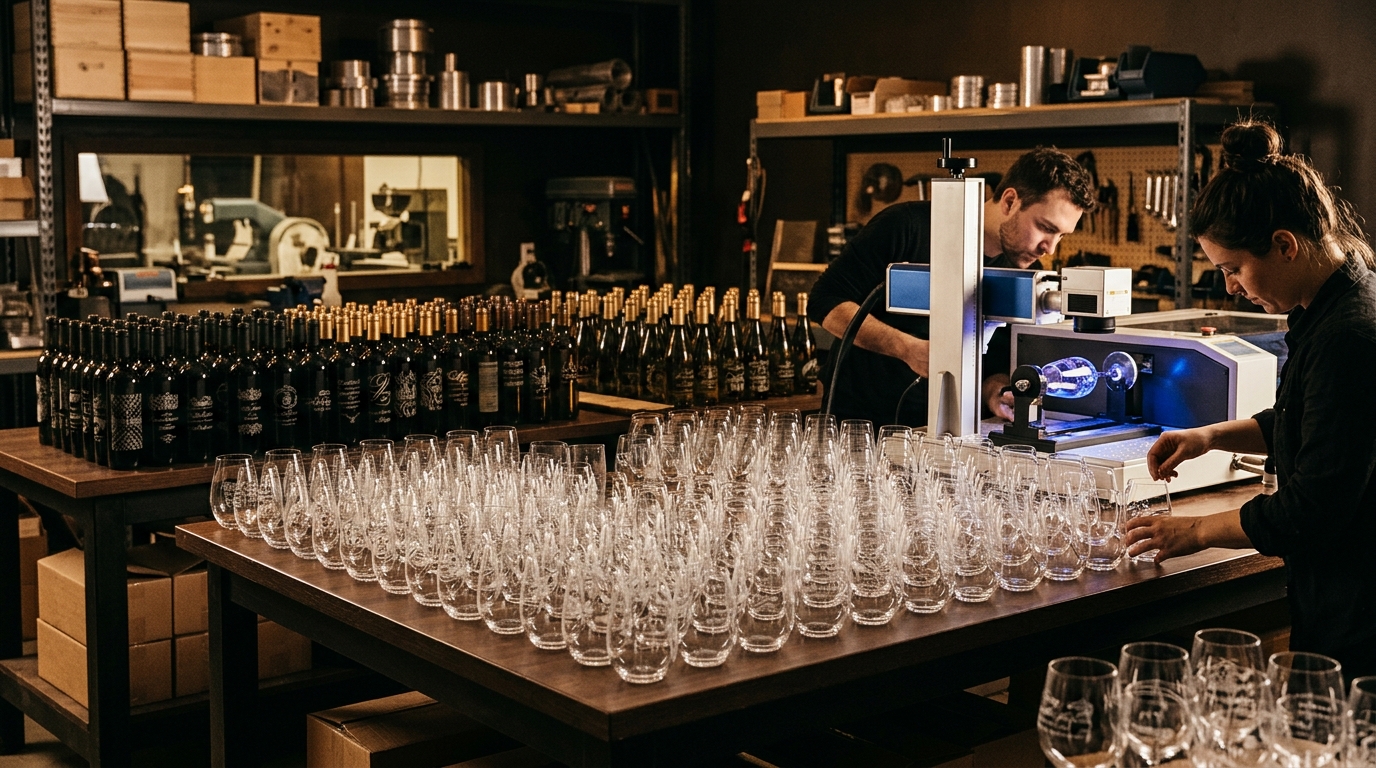
Going from 50 to 500 glass pieces isn't simply a matter of multiplying the effort by ten. For a gala, every glass and every bottle must carry a mark that is legible, consistent and durable, while absorbing the pressures of pace, breakage and handling. That is the whole challenge of custom glass engraving once it enters production. In this case study, we follow a real project: engraving 500 glasses and bottles for an event. We'll look at why volume changes the nature of the problem, how the choice of material affects the result, which technical trade-offs decide the project, and why laser wavelength, rotation of cylindrical objects, batch marking, serialization, real-world pace and uniformity between piece 1 and piece 500 become central. You'll also find out what your organization needs to plan for before launching a run of 500 pieces. The goal: turn a volume constraint into a controlled, repeatable and professional process.
The starting point: a gala and 500 pieces of glass to mark
An organization has entrusted us with 500 pieces of glass for its annual gala: stemmed glasses for service and souvenir bottles given to guests. The date is fixed and non-negotiable. This type of project falls under our custom engraving services.
At 50 pieces, as in several of our past projects, the job is easy to manage: a manual touch-up between two engravings goes unnoticed. The guiding question of this case study is therefore the following: what really changes when the volume is multiplied by ten?
All the figures cited, including pace, breakage and settings, come from our internal measurements at the Léry shop, not from machine manufacturers' spec sheets. What follows is the volume challenge, material choices, method decisions, measured results, and then the lessons that can be applied to your organization.
Why 500 pieces isn't ten times 50 pieces
Going from 50 to 500 pieces doesn't just multiply the work by ten. It brings three variables to the forefront: pace in pieces per hour, breakage rate and consistency of the marking from one piece to the next.
In a small run, a manual adjustment between two engravings costs nothing. At 500, every action is repeated 500 times, and so is every setting. Downtime becomes a cost item in its own right.
Breakage, for its part, is not linear. Handling, stacking, washing, packing and shipping each add a breaking point that a small run doesn't have. Glass packaging standards also provide for tests for impact resistance, vertical load and tightness, precisely because these stresses add up in production.
Uniformity becomes a matter of reputation. On a set gala table, a misaligned logo is noticeable to the naked eye.
Finally, a gala deadline doesn't move. Any production delay has to be made up with overtime or with quality sacrificed on the last pieces. That pressure is what drives the choices of material and method.
Choosing the material: what glass demands
The project brings together two items that are technically opposites. The stemmed glass has a narrow stem and a flat marking area; the bottle has a thick body and a continuous curve. A bottle absorbs laser energy differently than a thin stemmed glass, which rules out a single setting for both. Two geometries, two programs.
Marking both the front and back of a bottle adds a positioning constraint. Flipping is done with a jig, never by eye: without a physical reference, a one-millimetre offset gets repeated 500 times.
The desired result also guides the choice: high-contrast frosted engraving, a fine line, or a combination of engraving and colour-printed marking to reproduce the logo in the organization's colours.
One last filter, applied on receipt: set aside any glass with a manufacturing or tint defect. A defect visible on five pieces becomes visible on fifty in a batch of 500.
The method: three trade-offs that decide the project
Once the glass is selected, production comes down to three technical trade-offs: the laser's wavelength, the rotation of cylindrical objects and the organization of volume. These decisions shape the entire production rate.
Machine manufacturers describe these constraints well, but their vocabulary (series, equipment tiers, speeds) is meant to sell equipment. In the shop, the same reality translates into a commitment to the client: what finish for which glass, what precision held across 500 pieces, what deadline met.
Wavelength: which laser for which glass
For glass, the common options are fibre, CO2 and UV, with vanadate and green laser variants added depending on the case. Each behaves differently on a glass surface.
UV configurations are gaining ground in the current offering, promoted by several manufacturers for glass and crystal. The advantage: finer marking, with less risk of microcracks on thin pieces.
For the client, the name of the technology matters little. What counts is the contrast achieved, the fineness of the line and the absence of visible or structural microcracks.
A single batch can require two distinct settings. A thin stemmed glass and a thick glass bottle have neither the same thickness nor the same composition; that means two sets of parameters to validate on test pieces before launching the batch.
Rotation: the constraint of bottles and stemmed glasses
Once the wavelength is set, one constraint remains for the batch's cylindrical objects: rotation. For cylindrical pieces, the fixed focus of laser marking assumes the piece stays still, which is not the case here: each bottle and each stemmed glass must be engraved around its entire circumference.
The rotary engraver solves this problem with two motorized rubber-coated rollers that turn the piece through 360 degrees while the marking head works. Precision then moves out of the manual gesture and into the fixture: a repeatable setup reproduces the same position from one piece to the next, an essential condition for 500 units.
Two checks are needed before the full batch:
Stability on the rollers. A tall bottle whose centre of gravity shifts depending on its position in the jig can wobble or slip during rotation. The jig must hold it firmly, without constraining it to the point of throwing off the axis.
Rotation test on several pieces. A few units are enough to reveal alignment drift. If it goes undetected, that drift is then repeated on every piece in the batch.
At 500 units, it's the fixture that guarantees uniformity, not the operator's attention.
Volume: batch marking and serialization
Once the rotation is stable, the volume itself calls for a change in approach. It can't be adjusted: it's handled by equipment tier. A setup designed to mark hundreds of components in a single cycle replaces piece-by-piece repetition.
On a bottle, the curvature of the body causes focus to be lost at the edge of the marking zone. 3D compensation corrects this drift by adjusting the focal distance across the entire surface, which keeps the line sharp from one edge of the marking to the other.
Two scenarios coexist at a gala. Identical marking repeats the same logo on all 500 pieces. Unique marking per piece amounts to serialization: each glass carries a number, a name or a table assignment. The latter requires file management and individual checks that the former doesn't call for.
Finally, production order matters as much as the machine. Grouping pieces by identical setting reduces changeovers, and therefore the downtime between two runs.
The actual pace: what the shop measured
The measurements below are specific to this batch; your shop may see different results depending on its equipment and organization.
Once the pieces were grouped by identical setting, the measurement became clear. On this batch, the shop maintained a pace of 48 stemmed glasses per hour versus 24 bottles, whose two-sided engraving nearly doubles the cycle time.
The overall breakage rate came in at 2.1%: 0.4% attributable to the engraving itself, 1.7% to handling, packing and transport. The weight of the glass and repeated handling remain the leading cause of breakage, as across the glass industry as a whole, where musculoskeletal disorders accounted for 80% of recognized occupational illnesses in 2017.
The initial estimate was 14 hours; production took 19. The gaps can be named: repositioning for the second side, quality control, and cleaning and drying before packing.
Inspection covered all 500 pieces: alignment, depth, frosting uniformity. Twenty-three pieces were reworked, and seven were rejected and replaced.
Result: five business days from the first trial on a test piece to the last case, delivered three days before the gala. These figures describe the pace; they don't yet describe how consistent the result is from one piece to the next.
Uniformity: piece 1 and piece 500
After throughput, the question that shapes the client's perception is this: does piece 1 look like piece 500? For a gala, uniformity comes down to three observable criteria: identical logo placement, consistent marking intensity, and equal line sharpness across all 500 pieces. A difference that is invisible across fifty pieces becomes a flaw across five hundred.
The jig ensures this repeatability. It fixes the position of each stemmed glass and each bottle, reduces human variability and speeds up end-of-production checks, since a poorly placed piece is spotted at a glance.
A slow drift is still possible: a dirty lens, a setting that slips. A single check at the end of the batch catches it too late. So we inspect through regular sampling, following a lot-by-lot attribute inspection logic comparable to that of the ISO 2859-1 standard (2026 edition, currently in force), so that corrections can be made during production.
One point that is often forgotten: how well the marking holds up after washing or use. This is what separates a lasting keepsake glass from one that fades after a single service.
Uniformity is nonetheless what the client notices first, even without technical vocabulary: on a set gala table, a misaligned logo is visible to the naked eye.
What your organization needs to plan for with 500 pieces
Here is what an organization should lock down before confirming an order of 500 pieces.
Lock in the date before the quantity. At this volume, production must finish several days before the event, never the day before.
Provide a vector logo and precise marking instructions: size, position, number of sides to engrave. Each detail you specify eliminates a round of approvals.
Plan for an overproduction margin of a few pieces to absorb inevitable breakage, without having to rerun a full batch afterward.
Require a trial on one piece before the batch is launched, especially if the project mixes stemmed glasses and bottles, two supports with different settings.
Ask the shop four questions: stated throughput, historical breakage rate, rotation method used and uniformity control. Ask for a written inspection plan, in the spirit of the ISO 2859-1 standard, rather than an improvised check at the end of the batch.
The key lesson: 500 pieces are not a bigger version of a 50-piece project, but a different project altogether. A shop that has already handled this volume knows where the risks lie. Mr Trophée, in Léry, offers custom glass engraving for galas and events, with bilingual service and a best-price guarantee. Check out our services for the available techniques, or our shop to learn more. Information: 514-565-6665.
Conclusion
Engraving 500 glasses and bottles for a gala is not simple repetition. It is an industrial project on a human scale. Preparation (date, trial, inspection plan, breakage margin) determines the result. Start your trial today: your 500 pieces will be ready, uniform and on time.
You may also like
Case Study: A Youth Tournament Well Rewarded
This youth tournament case study shows how to plan trophies, medals and engraving for a clear, lasting and memorable on-site presentation.
Which industrial engraving method is right for your needs?
Industrial engraving provides durable identification for your equipment, plaques, trophies and signs. Compare laser, CNC and the right materials for your projects.
Perpetual Trophy: Planning Engraving Year After Year
Trophy engraving: plan the surface, material and marking so your perpetual trophy stays legible year after year. A practical guide and checklist to review before you order.