
Every end of season, a local soccer league found itself facing the same question: which trophies should it give to the teams, and at what price? Behind this apparent simplicity lay a costly reality. Cups, medals and plaques were bought one at a time, often from different suppliers, with sizes, materials and engravings that changed from one category to the next. The result: a budget that was hard to predict and an awards ceremony that was less cohesive than hoped.
This case study tells how the league went from a scattered annual order to a standardized range, ordered just once. We will look at the context of its end-of-season ceremony, the problem with one-off purchases, the hidden costs, and then the solution that was put in place. We will explain how to lock in sizes and engravings from the very first order, the results observed, the logistical and budgetary changes, as well as the lessons to take away for another amateur soccer league. Finally, we will offer concrete benchmarks for structuring your own range of trophies. Standardize once, present better every season.
The context: a local league and its end-of-season ceremony
An amateur soccer league in Quebec fields several categories each season, from U11 to U13 and U15 up to senior, divided into men's and women's teams. The schedule follows the warm season, from the first spring games through to the playoffs, and ends with a ceremony held on a set date in front of families and players.
Trophies are not handled by a purchasing department. They are ordered by volunteers: the events coordinator, the treasurer, sometimes the head coach. The budget is voted on at the start of the season, but the ordering window closes quickly after the finals, once the champions are known.
Like many Quebec leagues, it often works with local partners, sponsors, municipalities or facility managers. The ceremony is public, and the visual expectation is implicit: what families see on the table has to look good.
The sports trophy market already offers graduated sizes, and group buying is a common practice there. The league is therefore not inventing anything.
Starting point of the story: a functional organization, happy with its ceremonies, that had never questioned the way it ordered.
The problem: trophies bought one at a time every season
The league repeats this habit every season without questioning it. As soon as the playoffs end, it starts again from scratch: new shopping around, new catalogue comparisons, new models. The U13 championship trophy therefore doesn't look like the one given out last year, and the senior category doesn't get the same look as the U11.
In front of the families, spectators then see no progression between categories. A participation award can look more impressive than a senior title. The sporting hierarchy fades away and, with it, part of the ceremony's prestige.
This inconsistency adds to an already heavy volunteer workload: sport engages 31% of association volunteers, and the same steps start all over again every summer.
The Hidden Costs of Ordering Piecemeal
Behind these visible effects lies a cost structure that comes back every year. The league pays for the purchase of the trophies, then for engraving billed per piece. Add to that split delivery fees and catch-up orders for a forgotten name, an added category or a broken trophy. These small invoices add up without ever reaching a quantity tier. These extra costs build up precisely because each order stays below the volume discount thresholds. The most invisible cost is administrative: every season, a volunteer reopens the catalogues, compares models, validates prices and starts the selection over again, without reusing the previous year's work. For the case study to remain credible, every amount, quantity and turnaround time cited in this article must come from the league or the shop. No savings percentage, no unit price and no lead time will be made up. By contrast, a supplier that already organizes its offering by sport and by occasion, whether ceremony, challenge, seminar or community group, invites you to think in terms of product families rather than isolated pieces. That is the shift in approach that the rest of the story will explain in detail.
The Solution: A Standardized Range Ordered Once
Rather than starting the selection over every season, the league made a decisive break: define a range that belongs to it, with clear levels, and then repeat it.
The structure chosen has three or four tiers modelled on the sports hierarchy: participation or merit, finalist, category champion, and then a separate tier for individual honours depending on the league's needs.
The materials follow the same progression from one level to the next: acrylic for the participation tiers, metal or glass for the upper tiers. Visual consistency across categories takes priority over variety. A quote from the shop makes it possible to compare formats before finalizing these choices.
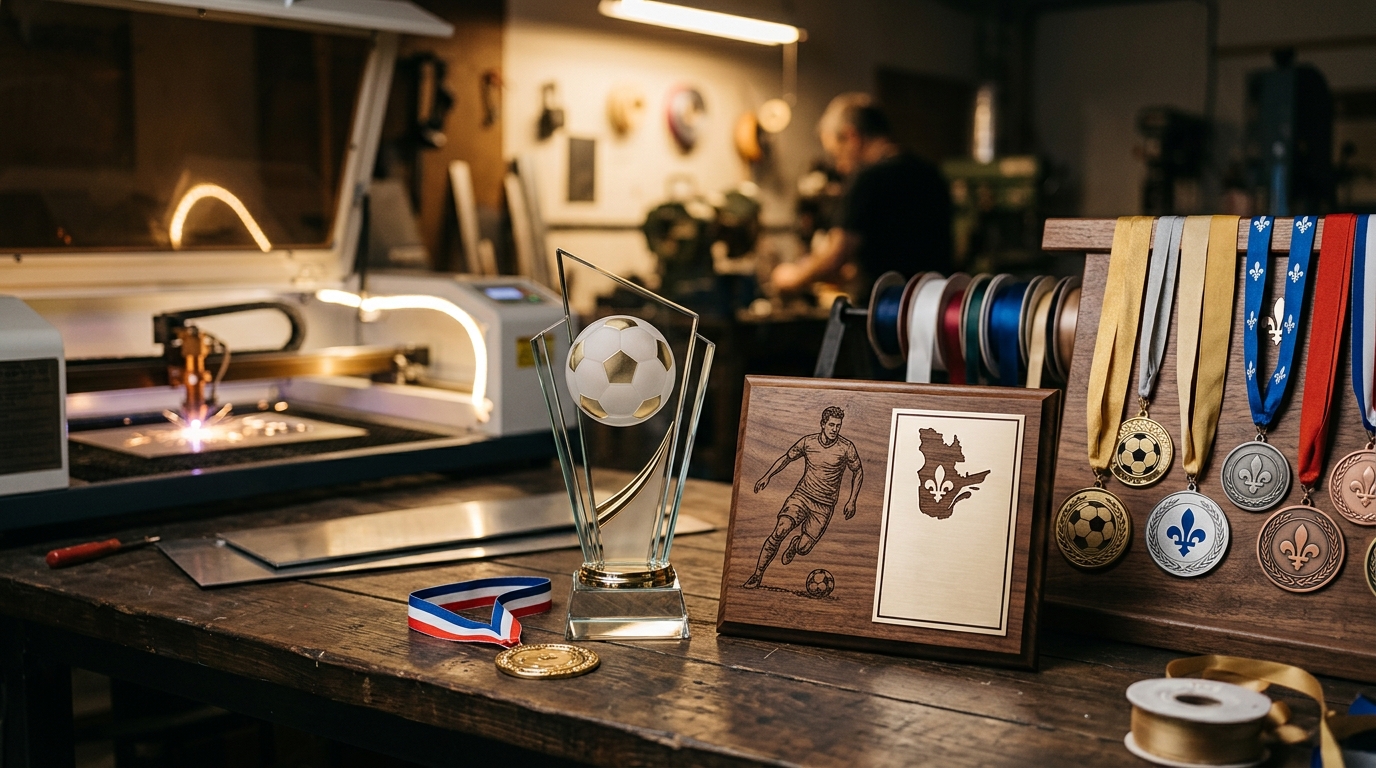
The partner shop then turns the range into production: laser engraving, colour printing and graphic design, all done in-house. The visuals are locked in, then reused season after season without drift. Based in Léry, in the Montérégie region, the shop supports the process from defining formats to approving an engraving template, with bilingual service and a best price guarantee.
One clarification is in order: ordering your range once does not mean buying all the trophies in advance. It means locking in the models, sizes and templates, then repeating the order every season. The shop keeps the approved references on file to make renewal easier each season.
Locking In Formats and Engravings From the First Order
This repetition relies on preparatory work done only once. The league lists its categories, assigns a tier to each one, calculates quantities by category and by tier, and then approves a multi-year budget.
Next comes the engraving template: placement of the league logo, category name, year, recipient name, and a clearly delimited variable area that avoids any need to redo the design. Special cases are planned for at this stage: ties, women's and men's teams, categories added mid-season, and trophies that are put back into play. The separation between the permanent piece and the individualized plaque is, moreover, an established convention, with Article 10 of the UEFA regulations dealing separately with the trophy, plaques and medals. An annual plaque affixed to a permanent trophy avoids having to buy a complete piece for a recurring championship and makes engraving part of an ongoing service.
What remains is logistics: a single order schedule, a deadline for validating the winners' lists, and a production timeline confirmed in writing. These figures come from the client, never from estimates. Our Léry workshop keeps these templates on file from one season to the next, among our 21 services.
The results observed after standardization
Once the product line and templates were set, the league measured what standardization had actually changed.
Figures that come from the league
The financial results presented here are based solely on the invoices and quotes provided by the league: total cost of the presentation before and after, average unit price per trophy, and the annual difference observed. No percentage, timeline or savings figure is put forward without this explicit source. Where this data is missing, the section remains qualitative.
A more credible look
The visual consistency becomes obvious: a family attending several presentations recognizes the same product line and can tell the tiers apart, from participation to champion. The perceived prestige among players and parents is strengthened as a result.
Streamlined logistics
One point of contact, fewer back-and-forth exchanges and virtually no more last-minute corrections: the ordering process is simplified from start to finish.
Replacing without starting from scratch
A broken or missing trophy can be replaced from the documented model, using the template that has already been approved, with no risk of incompatibility with the rest of the series.
What the league changed in its logistics and budget
Beyond the visible results, it is the internal workings that have been simplified. The presentation budget is now a stable line item, voted on at the start of the season, rather than an amount that varied depending on that year's finds.
The calendar has been turned around: the league validates its winners' lists in a template that is already prepared, then submits the order according to the agreed schedule, without end-of-season rush.
Permanent trophies and annual plaques also spread the expense over several seasons, since a single piece can be put back into play and added to rather than bought again.
Finally, the league documents what it does: a file of the models, tiers, quantities by category and engraving templates. This file can be handed off to a new volunteer without any loss of organizational memory, which protects the league against annual turnover.
Lessons for Any Other Amateur Soccer League
Beyond logistics and budget, the process leaves five lessons that apply to any amateur soccer league.
Decide by tier, not by piece. Three or four levels cover all categories and make the hierarchy clear at first glance.
Treat engraving as a deliverable. A template approved before the first order avoids reprints, misspelled names and last-minute corrections.
Order with real numbers. The exact number of categories, quantities per tier and the presentation date must be settled before locking in the range.
Centralize with a single supplier that engraves in-house. The visible market is made up mostly of catalogue resellers; multiplying sources undermines the consistency of an annual series.
Document the range. A simple specifications file avoids redoing the selection every year, even when volunteers change.
What remains is turning these principles into a concrete range.
How to Structure Your Own Trophy Range
Once these lessons are in place, standardization comes down to five steps.
Inventory. List every category and every individual honour at the end-of-season ceremony, sponsor awards included, without leaving any out.
Tiers. Group the categories into three or four levels and set a consistent material and size for each tier, keeping the same visual family from one level to the next. Metal, glass and acrylic are among our 21 services.
Engraving. Define the template once and for all and have it approved by the shop before the first production run.
Quote. Ask for a price on the complete range, with quantities per tier and the presentation date. The volume discount applies to the whole order, not to each piece.
Repeat. Plan the following season. Mr Trophée, a shop based in Léry, specializes in laser engraving, colour printing and bilingual service. To price out yours, browse our 21 services and request a quote at 514-565-6665.
Conclusion: Standardize Once, Present Better Every Season
Structuring your range is anything but theoretical. The league that bought its trophies piece by piece, season after season, faced two consequences: an inconsistent look from one category to the next and costs that came back every year. A standardized range, ordered just once, turned that logic around.
Standardization brings three lasting benefits: visual consistency that makes the sporting hierarchy clear, a stable presentation budget and a lighter volunteer workload season after season.
The decisive step remains locking in the formats and engravings from the very first order, even before calculating the total quantity. Once the template is approved, each season becomes a repeat rather than a new selection.
To validate an engraving template and get tier pricing before your next end-of-season awards presentation, contact Mr Trophée in Léry at 514-565-6665. Standardize once, and present better awards every season.
You may also like

Trophies and Medals for Soccer Tournaments in Quebec: A Guide for Organizers
Age categories, participation medals, individual awards: here is how to choose the right prizes for your soccer tournament. A practical guide for Quebec clubs and organizers.

Trophies and Medals for Soccer Tournaments in Quebec: A Guide for Organizers
Organizing a soccer tournament in Quebec and looking for the best awards for your players? This guide helps you choose personalized trophies, medals, and plaques based on your budget and event size.
Trophies and Medals for Soccer Tournaments in Quebec: A Guide for Organizers
Organizing a soccer tournament in Quebec requires careful planning, and trophies and medals are among the elements that leave a lasting impression. Here is everything you need to know to order your awards with confidence.