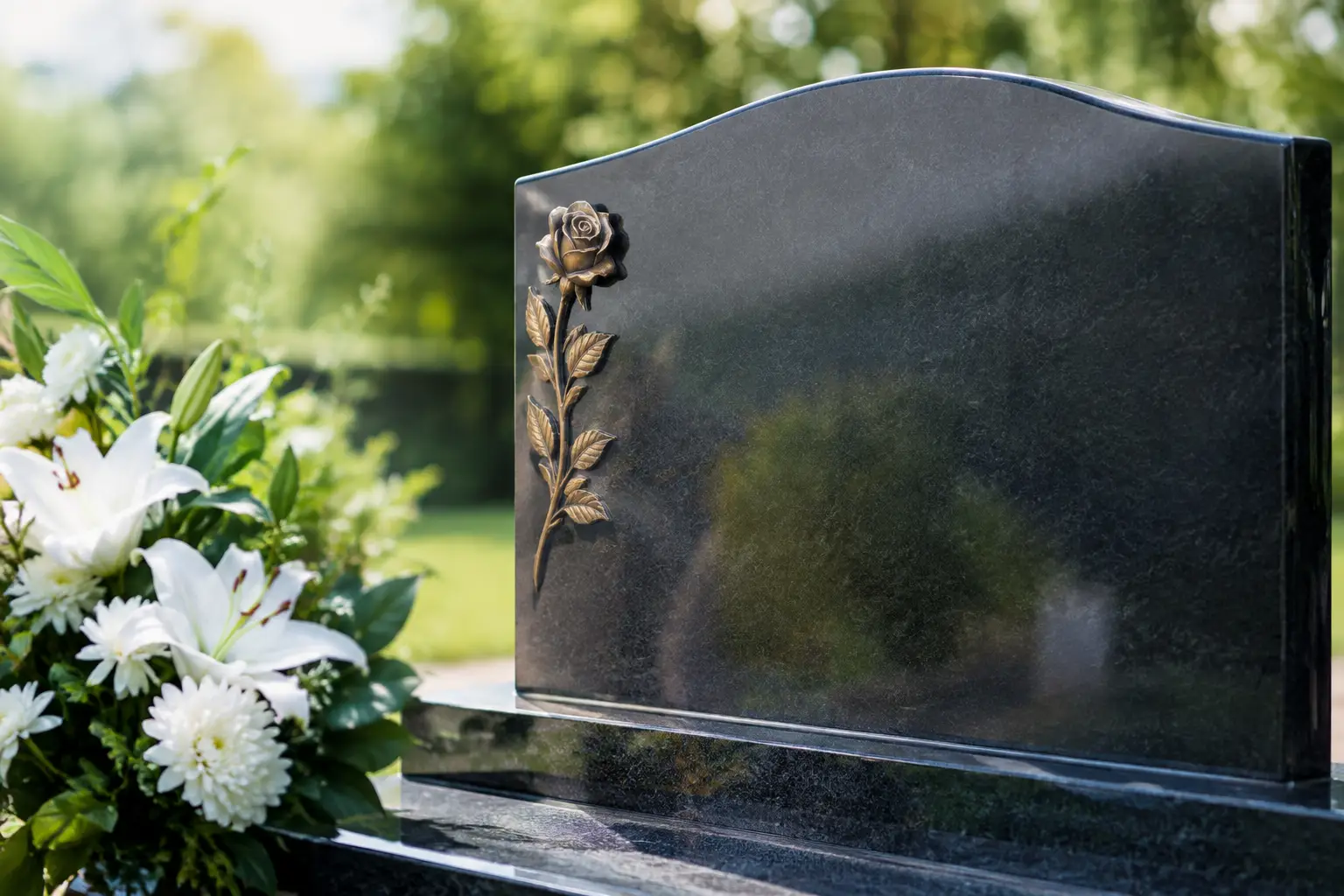
A memorial plaque must be easy to read, stand up to the passage of time and represent the person being commemorated accurately. Choosing memorial plaques therefore means looking beyond first impressions: the material, the installation site, the engraving method and the chosen text will all affect the final result.
Whether it is intended for a headstone, a columbarium, a family monument, a memorial garden or an urn, a plaque becomes a lasting marker. Making a few precise decisions at the outset helps you avoid an inscription that is hard to read, a format that doesn't fit or a material that is poorly suited to its environment.
Choosing a memorial plaque based on its location
The first criterion is not colour or design, but location. A plaque installed outdoors year-round faces different challenges than one installed in a mausoleum, on an urn or inside a memorial space. Rain, frost, temperature swings, UV rays and cleaning products can alter the appearance of certain materials over the years.
Before confirming a model, check the rules of the cemetery or place of remembrance. Some establishments require specific dimensions, a minimum thickness, a particular type of fastening, or have restrictions on colours, photographs and ornaments. These requirements vary from one site to another. Knowing them before production prevents you from ordering a plaque that cannot be installed.
The location also determines the viewing angle. A small plaque mounted vertically on a monument does not call for the same layout as a horizontal plaque set at ground level. In the latter case, stronger contrast and slightly larger lettering generally make it easier to read from a distance.
Materials: a matter of durability and character
Choosing the material means balancing aesthetics, durability and maintenance. No single material is universally better: the right choice depends on the location, the budget and the desired style.
Bronze is often chosen for outdoor plaques. It has a classic presence and works well for detailed inscriptions, borders and raised elements. Over time, it can develop a natural patina. Some families appreciate this aging, while others prefer periodic maintenance to keep a more uniform appearance.
Aluminum is a lighter option, practical when the plaque must be attached to an existing structure or when weight is a constraint. It can suit many commemorative signage projects, provided that its finish and mounting system are suitable for outdoor use.
Stainless steel produces a sleek, contemporary look that is very legible when the engraving contrast is well planned. It pairs especially well with modern architecture or a clean, minimalist landscape design. Its look can, however, seem more technical than that of bronze or stone, which does not suit every monument.
Granite and other natural stones create a cohesive look with many funerary monuments. The engraving can be subtle or high-contrast depending on the stone and the finish. Dark granite, for example, often offers excellent legibility with light-coloured engraving, whereas a heavily veined stone requires extra care so that the text doesn't get lost in the natural pattern.
Plaques made of laminate or engraved plastic can be suitable for indoor, temporary or very specific uses, such as identifying a niche, a stand or a memorial space. For a permanent outdoor installation, it is best to discuss exposure conditions with the manufacturer.
Legible engraving above all
A funerary inscription doesn't need to be elaborate to be moving. The name, the dates and a short message are often the best foundation. Legibility depends on the balance between the amount of text, the size of the plaque and the choice of lettering.
Highly decorative fonts may look elegant on screen but become hard to read once engraved at a small size. Clean letters with enough spacing produce a longer-lasting result. Initials, accents, hyphens and dates must be checked with great care before engraving begins. A tiny mistake takes on enormous significance on a memorial piece.
The marking method also affects the final look. Laser engraving suits many materials and offers great precision for text, fine illustrations or certain photographs. CNC engraving, for its part, makes it possible to create deeper markings depending on the material and the project. For an outdoor plaque, depth, contrast and finish should be evaluated together rather than separately.
A mock-up is especially helpful before production. It lets you confirm the spelling, layout, margins, character size and overall appearance. If several family members are involved in the decision, approving a mock-up reduces misunderstandings and allows you to choose with peace of mind.
What text should go on a memorial plaque?
The text can be traditional, personal or institutional. The right choice is the one that honours the person's memory and fits the available space. The full name and the dates of birth and death are the most common elements. You can add a family relationship, a role, a short phrase, a verse or a expression of affection.
It is best to keep the wording concise. A plaque is not a biography: a few well-chosen words will have more impact than a long text squeezed into characters that are too small. "Forever in our hearts," "Beloved husband, father and grandfather" or a phrase that is meaningful to the family may be all you need.
For a collective tribute, such as one from an association, municipality, school or organization, the tone will often be more factual. The person's name, years of service, contribution and the name of the organization create a clear and respectful acknowledgment. In this case, adding an engraved logo can be appropriate, provided it remains secondary to the name being commemorated.
Size, mounting and visual details
The size should give the text enough space without creating a plaque that is out of proportion with the monument or mounting surface. A plaque that is too small requires smaller lettering. Conversely, a very large plaque can draw attention away from the setting as a whole. The best proportion depends on the available surface and the distance from which visitors will read it.
Rounded or square corners, the presence of a border, the background colour and a matte or glossy finish all change the character of the plaque. A matte finish often limits glare in a very bright environment. A contrasting background improves legibility, especially for names and dates.
The mounting deserves the same attention as the engraving. Screws, rods, specialty adhesive or recessing into stone are not suited to the same surfaces. The choice depends on the weight of the plaque, its exposure to the elements and the requirements of the site. A poorly suited mounting method can compromise an otherwise well-designed product.
Preparing a customization request
To get an accurate quote, gather the final text, the desired or permitted dimensions, the type of installation, your material preferences and any image to be reproduced. A photo of the location or monument also helps in proposing a coherent size. If a logo, religious emblem, signature or illustration is being considered, provide the sharpest file possible.
An engraving specialist can advise on the choice of material, the marking technique and the mock-up. At M. Trophy, customization and engraving are approached based on the actual mounting surface, the artwork to be reproduced and the level of detail desired. This approach is helpful when a plaque must blend in with an existing monument or meet set dimensions.
Finally, allow the time needed for approvals. A memorial plaque deserves a careful proofread, particularly for names, dates and bilingual messages. When every detail is confirmed before production, the finished piece can fulfill its role simply: preserving a name, marking a presence and giving loved ones a lasting place of remembrance.
You may also like
How to Recognize Your Volunteers: Plaques, Medals and Trophies That Make an Impression
Your volunteers give their time freely. Here is how to choose an engraved award that truly says thank you, with ideas, budget tips and advice for Quebec clubs and organizations.
Vinyl Decals or Lettering: Which Should You Choose?
Cut vinyl or lettering: choose the right solution for your windows, vehicles and spaces, with a durable, precise and professional finish.
Silk screening or heat transfer, which one should you choose?
Screen printing or heat transfer: compare durability, colours, volumes and fabrics to choose the right marking method for your long-lasting custom apparel.