An unmarked door creates hesitation, slows down welcoming visitors, and sometimes gives an impression of improvisation. Whether for an office, a meeting room, a classroom, a clinic, or a utility room, searching to "order door sign" really comes down to wanting clear, durable information tailored to the space. The right product isn't chosen solely by its colour: it must meet a specific use, a mounting method, and a precise professional image.
Ordering a door sign based on use
A door sign can guide visitors, identify a person, indicate a function, or display instructions. These goals may seem similar, but they directly influence the format, material, and content required.
In a company, a door plaque can display an employee's name, title, and office number. In a school or municipality, it is often used to identify a room, department, or specialized area. For a clinic, professional office, or lodging facility, it must be particularly clear and consistent with the rest of the signage.
The context matters as well. A plaque placed indoors in a quiet hallway doesn't have the same requirements as a sign installed near an entrance exposed to temperature changes, humidity, or frequent handling. Before choosing a model, you must therefore define what the plaque needs to communicate and under what conditions it will be used.
Identifying a permanent space or a changing function
A conference room, electrical room, or restroom generally keeps the same function for several years. A permanent engraved sign is then a logical choice. Conversely, workstations, professional offices, classrooms, or seasonal spaces may require a more flexible solution.
Nameplates with interchangeable inserts work well in environments where occupants change regularly. They allow you to replace a text strip rather than the entire plaque. This option reduces replacements and helps maintain a uniform appearance across a building, school, or administrative department.
Materials for durable signage
The material sets the visual tone of the sign, but it also determines its durability. A door plaque must stay clean and sharp despite cleaning, light impacts, and daily use.
Lamacoid is a common choice for engraved plaques. This multi-layer plastic reveals a contrasting colour when text, numbers, or pictograms are engraved. It offers crisp readability and comes in several colour combinations. Black and white, blue and white, red and white, or silver and black meet very different needs, from utility rooms to executive offices.
Aluminum offers an understated, professional look. It is suitable for office numbers, nameplates, and various institutional applications. Stainless steel or metallic finishes may be preferred when the décor calls for a more contemporary or high-end look. However, you must check the type of engraving and chosen finish to ensure sufficient contrast is maintained.
Acrylic and plastic can also produce a clean, lightweight, and modern sign. For a glass door, a clear or frosted plaque can blend in subtly, provided the text remains visible from the approach area. Wood, leather, or glass may be suitable for decorative or commemorative projects, but they require further consideration regarding legibility and mounting.
Contrast, Font, and Dimensions: Legibility First
An elegant sign that cannot be read from a few steps away loses its primary function. The contrast between the background and the lettering must be sufficient, especially in a dimly lit hallway or on a dark door. Light text on a light background may look subtle on a screen, but become difficult to spot once installed.
Font size depends on the viewing distance. For a name and title seen up close, a compact plaque may suffice. For a room number or a designation meant to be spotted down a hallway, a larger format and simple characters are often preferable. Very fine, decorative, or condensed fonts can hinder readability, particularly for visitors and people walking by quickly.
A logo is useful when it supports an organization’s identity, but it should not take away from the main information. On a small plaque, the room name or number must remain the priority. Graphic design allows these elements to be balanced before launching production.
Information to Prepare Before Ordering
A clear request speeds up quote preparation and limits revisions. When ordering multiple door signs, it is helpful to provide a structured list, even if all details are not yet final.
The following details are particularly helpful:
- the exact text for each door, including accents, titles, numbers, and desired capitalization;
- approximate dimensions or location constraints;
- desired material, colours, and style, if already known;
- the logo in a high-quality file, ideally vector;
- quantity, required dates, and mounting specifics.
For a large series, consistent numbering deserves careful checking. A simple error in a room number, name, or floor can result in an unnecessary replacement. Schools, community centres, office buildings, and municipal facilities benefit from validating a final list with facility managers before engraving.
Engraving, Printing, and Customization
Laser engraving is particularly well-suited for small and medium-sized plaques, precise text, numbers, pictograms, and various materials. It produces a clean, durable marking. CNC engraving is also an effective solution for certain materials and for plaques requiring a specific depth or finish.
Printing may be recommended when a visual includes multiple colours, gradients, or graphic elements that are difficult to reproduce through engraving alone. The choice depends on the material, the number of pieces, and the expected level of durability. An indoor sign for a temporary campaign does not necessarily require the same method as an institutional plaque meant to remain in place for years.
When an organization wants to harmonize its doors, office plaques, badges, nameplates, and directional signage, it is best to establish a simple style guide: colours, font, title format, and logo placement. This consistency makes future orders easier, especially when multiple departments or buildings are involved.
Mounting: a detail that should be decided early
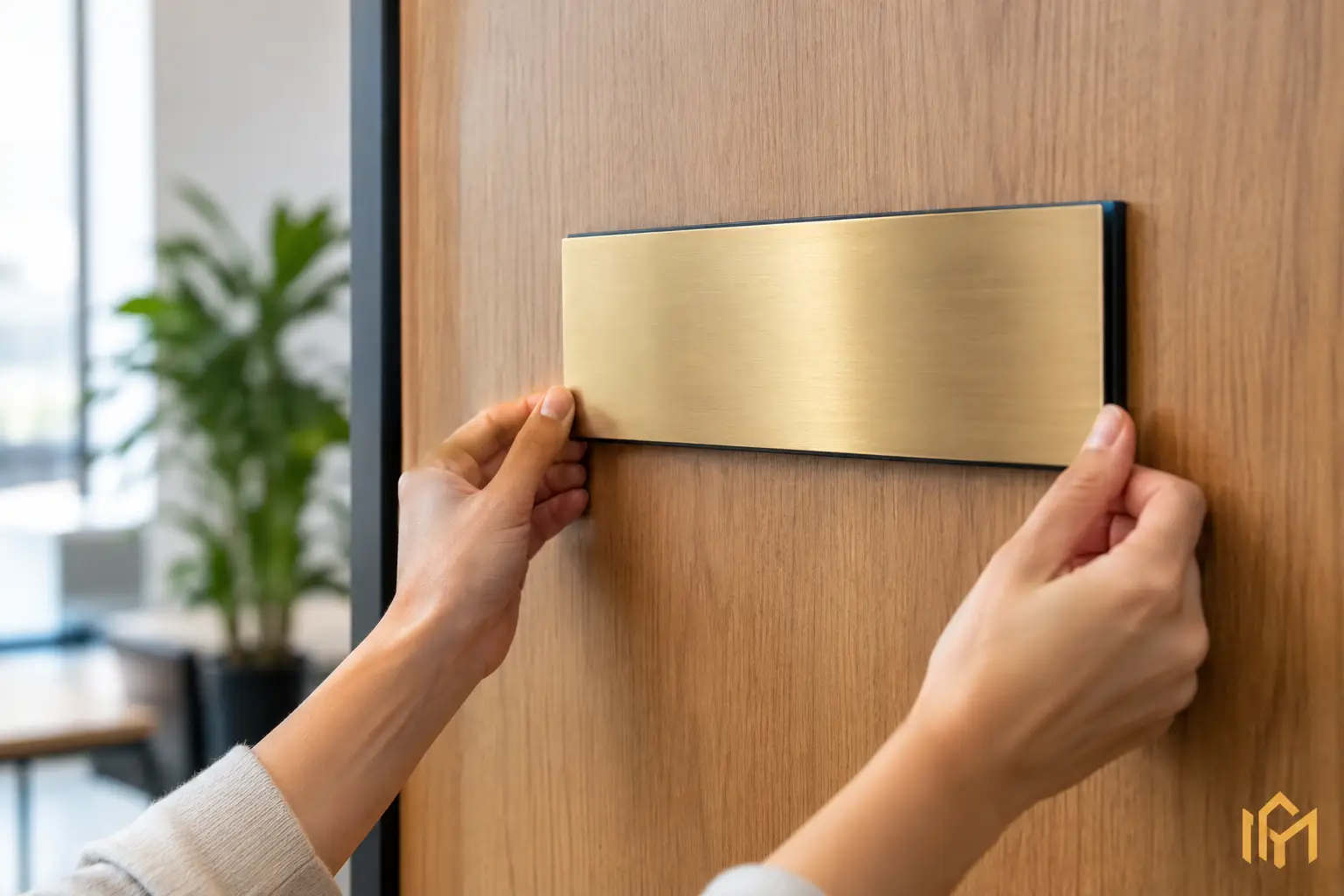
The installation method should be chosen prior to manufacturing. A plaque can be mounted with high-quality double-sided adhesive, screws, standoffs, a sliding bracket, or an interchangeable system. Each option suits a different situation.
Adhesive works well for smooth doors and quick installations, particularly on panels or clean indoor surfaces. However, it requires proper preparation: a dusty, textured, or uneven surface can compromise adhesion. Screws offer a more permanent and resistant installation, but require drilling into the door or wall. Standoffs create a more architectural look, often appreciated in professional offices and reception areas.
For a fire door, a glass door, a metal frame, or a surface subject to specific maintenance rules, it is wise to confirm constraints with the building manager. The choice of mounting can also depend on the need to remove or update the sign without leaving marks.
Planning lead times for an organized order
Production lead time depends on the quantity, material, graphic complexity, and text approval. A single plaque with a name and number can be relatively simple to prepare. A series of dozens of plaques, each with different content, requires more checks before engraving or printing.
For a move, the back-to-school season, the opening of a new office, or the reorganization of a floor, it is best to gather the information in advance. Planning for a few blank plaques or interchangeable systems can also be useful when staff changes are expected. This avoids having to redo an entire series for a single update.
At Mr Trophée, our engraving, graphic design, and signage production allow us to tailor an order whether for a single office plaque or a coordinated set for an entire organization. A proof approved before production helps confirm the text, dimensions, and layout of every element.
A good door sign doesn't try to draw unnecessary attention: it provides the right information, in the right place, with a finish that remains professional over time. By preparing the content, material, and installation right from the start, you get signage that truly guides people through your spaces.
You may also like

Ordering Custom Trophies: How Much Time to Plan and How to Stay on Schedule
Gala in three weeks? League final this Saturday? Here is a realistic timeline for a custom trophy order, plus our tips for saving time without sacrificing quality.
A 72-Hour Engraving Rescue for a Late Award Order
See how a Quebec engraving shop rescued a late award order in 72 hours: the triage rules, the single proof, and the details that never get sacrificed.

Designing a custom trophy that makes an impression
Learn how to design a custom trophy for a tournament, a team or workplace recognition by choosing the right format, material and durable engraving.