October 16, 2026
Appreciation Gifts for Clients and Partners: When Recognition Goes Beyond the Employee

Your employees deserve to be recognized, and organizations generally know how to do it. But who thanks the partners, volunteers and long-standing clients who carry part of the results? That question is at the heart of this article. Recognition is almost always designed with employees in mind, even though these stakeholders also contribute to the mission and to performance. Engraved appreciation gifts, like several well-chosen corporate gifts, can fill that gap, provided they respect tax thresholds and each organization's internal rules.
In this tutorial, we'll look at why partners so often come last, then at how to recognize those who deliver results without being recognized. We'll draw the tax distinction between gifts to employees and gifts to non-employees, and we'll examine what the CRA and Revenu Québec say about gifts, awards and social events. We'll also compare gift cards and engraved items, before turning to donations and gifts in terms of GST/QST for municipalities, NPOs and public service bodies. Finally, we'll structure an internal policy with thresholds and documentation, then set up a program of engraved appreciation gifts that follows the rules.
Employee recognition: why partners always come last
In most organizations, recognition is an employee program before it is a relationship practice: seniority scale, performance awards, farewell gift, recurring budget, documented policy.
This reflex is understandable: the employer-employee relationship rests on a paycheque, an HR file and source deductions, which means an administrative channel is already in place. Gifts and awards are treated there as taxable benefits, as are long-service awards at the federal level.
For a partner, a volunteer or a long-standing client, none of this exists: no paycheque, no HR file, no standard approval process. No one is explicitly responsible for thanking them; recognition falls between the cracks.
The cost of this oversight remains invisible: dependence on a few key partners, quiet disengagement among volunteers, informal retention of longtime clients.
This article makes a simple argument: recognition must move beyond the employee framework alone, provided it is structured according to the recipient's actual status. The engraved appreciation gift, often filed under corporate gifts, stands out as a versatile format. The perspective is Quebec-based, supported by official sources from the CRA and Revenu Québec.
Partners, volunteers and long-standing clients: those who deliver results without being recognized
This observation applies to three distinct profiles. The partner or sponsor opens up markets and lends their credibility. The volunteer carries an activity on their own, often without a written mandate. The long-standing client represents a stable share of revenue.
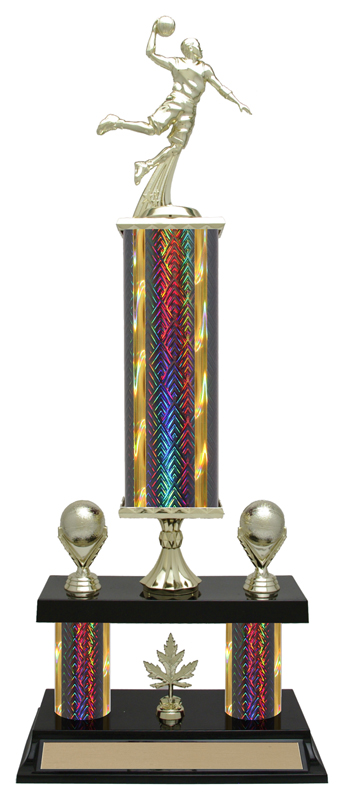
A verbal thank-you or a social media mention fades away. An engraved item, whether a plaque or a trophy, stays visible in the recipient's space and becomes a verifiable record of the relationship.
Five moments call for a tangible gift: the renewal of an agreement, the end of a volunteer mandate, a collaboration anniversary, the retirement of a key client, and public recognition at an event. The effect is twofold: it builds loyalty with the individual, and it shows other partners and potential volunteers that their contribution is noticed.
The engraved format also suits organizations that need to recognize several people at once, at a gala, a general meeting or a municipal event.
Notable gap: regulatory content and recognition suppliers deal almost exclusively with employees, even though gift policies for third parties are already documented, notably in the compliance guide on gifts to third parties (as an international best-practice reference, this guide does not replace applicable Canadian obligations).
What remains is determining the recipient's status: it is what determines the applicable tax treatment.
Gifts to employees or corporate gifts to non-employees: the tax distinction to understand
Once this distinction is established, the gift falls under a different regime depending on who receives it. As a reminder: a gift to an employee is a taxable benefit processed through payroll, see Revenu Québec and the CRA Employers' Guide. For a non-employee, source deductions are no longer the central question. You need to check whether the expense is deductible and how it is treated for GST/QST, depending on the beneficiary's exact status.
A volunteer, a subcontractor, a business partner or a client is not an employee. Their gift does not trigger source deductions, but it raises other accounting questions. The line is blurry if the volunteer is paid through an allowance or if the person is related to the organization. Validation with an accountant is then necessary.
Practical rule: determine the recipient's status before choosing the format. The status determines the tax treatment and the documentation required.
No threshold or exemption should be quoted from memory. The amounts that apply in 2026 should be checked directly on the official CRA and Revenu Québec pages, whose administrative policies were recently revised, as reported in this tax alert.
What the CRA and Revenu Québec Say About Gifts, Awards and Social Events
These official references deserve a closer look. In its payroll deductions section, the CRA has a page dedicated to gifts, awards and long-service awards, which explains how these benefits affect source deductions and contributions. Revenu Québec includes gifts and awards in its list of taxable benefits for employers, a status already established in the previous section. The Québec tax authority also treats social events as a separate category of taxable benefit: recognition therefore falls under a broader compliance framework than the gift itself.
These rules are evolving. In its Tax Alert 2023 No. 01, EY reports that the CRA announced changes to its administrative policies on certain taxable benefits for employees. The current state of the rules should therefore be rechecked for 2026 rather than relying on an earlier reading.
Two levels of government, two parallel and updated bodies of guidance: a Québec organization must consult both the CRA and Revenu Québec, not just one of them. Since these texts do not directly cover gifts to a partner, a volunteer or a client, an internal policy is needed to fill that gap; see the dedicated section below.
Gift Cards or Engraved Items: Which Appreciation Gift Format to Choose
These rules apply to employees; the choice of format, however, arises for every type of recipient. Revenu Québec devotes a separate page to gift cards and gift certificates with respect to GST/HST and QST: this format therefore raises its own tax questions, which should be validated based on the context in which the card is issued.
The gift card appeals because of its flexibility for the recipient, its quick purchase and an amount that is easy to calibrate to the level of contribution. Its limitations are real: it leaves no lasting trace, and it is perceived as a transaction rather than as recognition.
The engraved gift (trophy, plaque, personalized item), by contrast, gives the relationship a tangible form. It remains visible on the recipient's premises and carries a personalized message that is hard to trivialize. Engraving makes it possible to adapt the same item to different audiences, whether partner, volunteer or client, simply by changing the text and the level of finish. This simplifies the logistics of a program involving multiple stakeholders, as our projects and our shop show.
A hybrid approach remains the most effective: an engraved item presented in front of witnesses for relationship impact, and a gift card or voucher when discretion or the recipient's preference takes priority. Our range of services covers trophies, plaques and personalized items in small or medium runs.
Municipalities, NPOs and Public Service Bodies: Donations and Gifts for GST/QST Purposes
Once you have decided between a gift card and an engraved item, one question remains for municipalities, NPOs and public service bodies: GST/QST treatment.
Revenu Québec specifically addresses donations and gifts in its GST/HST and QST documentation for public service bodies. This matters, because these organizations represent a major client segment for engraved recognition and fall under a distinct tax regime, including rebates of their own.
Donation or Recognition Gift: A Key Distinction
A donation is given with no consideration expected in return. A recognition gift, often a personalized corporate gift, stems from a contribution. This difference shapes the tax treatment and the accounting traceability.
Authorization and Documentation
Before committing to the expense, make sure you have a resolution, a policy or a clear delegation of authority. For each gift, keep the supporting document, the recipient's name, the reason and the approval obtained to make any later audit easier.
Tight budgets and calls for tenders often characterize these organizations. A standardized, repeatable format, for example an engraved trophy available in several sizes, makes internal compliance easier and speeds up orders. It also lays the groundwork for the written policy detailed in the next section.
Internal Policy, Thresholds and Documentation: Structuring Recognition Beyond Employees
GST/QST compliance is only one piece of the puzzle. To structure recognition beyond employees, a written policy must specify who may receive a gift, when, for what amount and with what approval.
A Grid by Recipient Category
Set a distinct gift level for each group:
Partner or sponsor: recurring contribution, visibility.
Volunteer: sustained involvement, completed term.
Long-standing client: loyalty, collaboration anniversary.
Supplier: exceptional service, continuity.
This grid prevents improvised decisions and inconsistent treatment of people with the same status.
A Centralized Register
At a minimum, record the recipient's name, status, the reason, the date, the value, the format and the authorization. A single register makes internal checks and audits easier.
Thresholds, Ethics and Annual Review
(see thresholds, previous section). For a public sector client or a decision-maker, ethics and conflict-of-interest rules apply: perception matters as much as compliance. Finally, plan for an annual review, since federal and Quebec administrative policies evolve and the 2026 version must reflect the rules in force.
With this policy in place, all that remains is choosing the format and rolling out the program.
Setting Up an Engraved Appreciation Gift Program
Once the policy is written and the thresholds are validated, the program rolls out in six simple steps that you can repeat every year.
Step 1: Qualify non-employee recipients. Confirm the status of each partner, volunteer or client you plan to recognize, as established in the previous section: it determines the applicable tax treatment.
Step 2: Set a budget for each category. Assign a gift level to each category, in line with your internal policy and with the tax rules that apply to non-employees.
Step 3: Choose a repeatable format. A trophy or engraved plaque available in several sizes reduces unit costs and speeds up repeat orders.
Step 4: Engrave a specific message. Name, contribution, occasion: a personalized message turns the item into proof of recognition rather than a generic gadget.
Step 5: Plan the presentation. Favour a moment in front of witnesses, at an event, then record the transaction in the internal register along with the supporting document.
Step 6: Measure the results. Track the length of relationships, the renewal rate of agreements and volunteer participation so you can adjust the program from one year to the next.
For production, our range of services covers trophies, plaques and personalized items in small or medium runs. Visit our shop in Léry to get started.
Conclusion: Recognizing those who deliver results, by the book
The program is in place; all that remains is to draw the big picture. Employee recognition is well regulated, but it leaves in the shadows the partners, volunteers and long-standing clients who nonetheless contribute to the results.
To determine the recipient's status and choose the right tax regime, refer to the sections on the tax distinction and on what the CRA and Revenu Québec say. Then rely on the internal policy described above to frame categories, approvals and the register. Favour a format that leaves a lasting mark, such as an engraved item presented publicly, rather than an anonymous, interchangeable corporate gift.
Next step: identify ten non-employees to recognize this year, validate their status, then place a first order of personalized engraved gifts. Mr Trophée offers trophies, plaques and personalized items to support this process. Non-employee recognition will then become a practice as rigorous as the one reserved for employees, but far more distinctive.
You may also like

Why Employee Recognition Awards Get Abandoned After Year One
Employee recognition awards fail when they are consumable. Learn why durable, personalised awards keep recognition visible and how to fix your program.
Employee Recognition Plaques: How to Reward Loyalty and Performance in the Workplace
A well-chosen engraved plaque turns a simple gesture of recognition into a lasting memory for your employees. Discover how to personalize your corporate awards with style and sincerity.

Engraved Corporate Gifts in Quebec: Ideas to Recognize Your Employees and Clients
An engraved corporate gift leaves a lasting impression and strengthens professional relationships. Discover our best ideas for every business occasion.