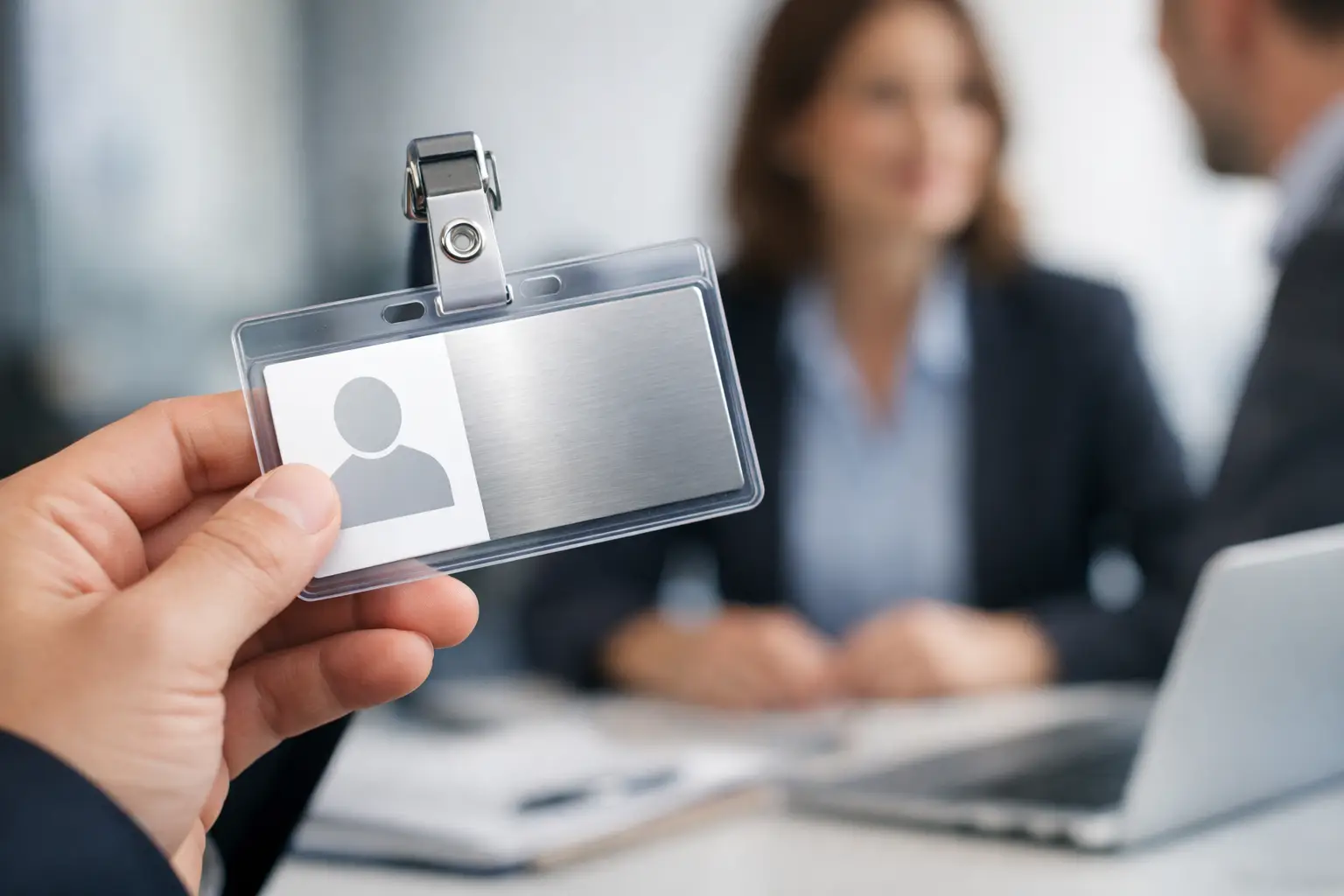
At a hotel front desk, in a retail store, at a conference or within a municipal department, the personalized employee name badge does much more than display a first name. It helps the public quickly identify the right person, gives teams a consistent presence and reflects the organization's visual identity. Yet a badge that's too small, poorly contrasted or uncomfortable to wear often ends up in a drawer.
The right choice depends on very practical factors: daily or occasional use, the work environment, the quantity needed, the graphic charter and the personalization method. For an order that's durable and easy to manage, it's worth thinking of the badge as an identification tool, but also as a piece of mobile signage.
Define the use before choosing the format
Not all badges serve the same purpose. A receptionist, a retail sales associate, a volunteer at an event, a teacher or a member of a care team don't use their badge under the same conditions. Before settling on a material or a fastener, it's important to clarify how often the badge will be worn, what type of clothing it will be worn with and its expected lifespan.
For a permanent team in regular contact with customers, a sturdy and understated model is generally preferable. Rigid engraved or printed badges hold up well to daily handling and maintain a professional appearance over time. For a trade show, conference or fundraiser, a lighter badge may be appropriate, as long as the information remains legible at a normal conversational distance.
Size also matters. A first name should be readable without the other person having to lean in. Including the full name, job title, logo and sometimes a department requires sufficient surface area. Trying to fit everything onto a very small format often reduces the badge's effectiveness. In certain contexts, it's better to limit the text to the first name, the logo and a short title.
Materials for a personalized employee name badge
The material determines the appearance, durability and marking options. It should be chosen based on the work environment and the desired image, not just the unit price.
Engravable plastic such as Lamicoid is a common solution for organizations looking for a durable, clean and easy-to-reproduce badge. Its multilayer structure allows a colour to show through the surface when engraved. A black background with white engraving, a metallic look with dark lettering or a colour combination tied to the visual identity are all possible. This option works equally well in offices, retail stores, schools, associations and municipal facilities.
Aluminum offers a more institutional or contemporary finish. Depending on the technique used, it can feature text, a logo or variable information. It is a popular choice for reception roles, management teams, dealership employees and environments where a more upscale presentation is desired.
Acrylic offers a different visual aesthetic, particularly with transparent, frosted, or coloured effects. Its intended use should be taken into account, however: a very thin or transparent badge may be elegant in an administrative setting, but less suited to a position involving frequent physical impact. Wood, leather, or other specialty materials can also support a craft, tourism, or event-driven image, when maintenance requirements and consistency with uniforms allow for it.
Engraving, printing, or marking: choosing based on the visual
Customization is not solely a matter of text. The manufacturing process influences the sharpness of the logo, the colour rendering, and the durability of the identification.
Laser engraving is particularly well suited to names, job titles, numbers, and simplified logos. It produces precise, long-lasting marking without any added ink that could wear over time. On certain materials, it reveals a contrasting colour layer; on others, it creates a discreet and refined finish. It is highly effective when each badge needs to display a different name.
CNC engraving is a strong option for thicker plates, relief work, or projects requiring precise machining. It fits naturally into the production of coordinated signage: staff badges, door plates, equipment identification plaques, and room markers can all share the same graphic codes.
Printing and screen printing are better suited to colour logos, detailed graphic elements, or visuals that must adhere to a specific colour palette. They can be combined with an engraved base depending on the desired result. The choice then depends on volume, number of colours, the intricacy of the visual, and the level of exposure to wear. A photograph, for instance, often calls for a different solution than a simple engraved name.
Before production, a good-quality logo file remains essential. Vector files facilitate clean reproduction of shapes, while a visual that is too small or blurry limits precision, regardless of the technique chosen. A graphic design service can prepare or adjust the artwork to ensure a legible result in the chosen format.
The fastener genuinely affects wearing comfort
A well-designed badge should stay in place without damaging clothing or restricting movement. This decision may seem secondary, but it directly influences how consistently staff members actually wear their badges.
The pin fastener is economical and works well with thicker fabrics. That said, it can leave marks on certain uniforms, blouses, or fine knits. The magnetic fastener avoids piercing the garment and offers a very clean presentation. It is well suited to front-desk staff, sales teams, and corporate events. It is nonetheless important to check applicable guidelines for individuals wearing certain medical devices and to have an alternative option available as needed.
The clip-with-pin offers a degree of versatility, while the lanyard badge holder is often reserved for events, visitors, or temporary access situations. In sectors where a badge must be removed quickly for safety reasons, a fastener compatible with internal practices should be selected. Trying the fastener on an actual uniform is worthwhile before confirming a large order.
Creating a Readable and Consistent Design
A name badge should not become a mini-brochure. Its primary function is to make a person identifiable, quickly. The name must therefore occupy a clear position and have sufficient contrast against the background. An overly decorative font, thin lettering, or too much information can all make the badge harder to read.
For a bilingual organization, it is possible to include a job title in both languages, but careful thought should go into what appears on each badge. A concise phrase like Accueil / Reception often works better than a lengthy title. If roles change frequently, a design with an interchangeable insert can reduce replacements, whereas a permanently engraved badge is better suited to a stable team.
Visual identity benefits from remaining consistent. Using the same colours, logo placement, and typography across badges, door plates, and interior signage reinforces a sense of organization. This consistency is particularly valuable in schools, clinics, municipalities, sports centres, and businesses with multiple departments.
Planning for Staff Changes and Reorders
The first order is only one part of the project. New hires, departures, role changes, and seasonal events create recurring needs. Planning from the outset for a reproducible format, material, and design simplifies reorders and prevents visual discrepancies between older and newer sets.
It is helpful to maintain a validated list of names, titles, and spellings. This step limits costly corrections, especially when accents, hyphens, or official titles must be respected. For a bulk order, a final review of the list and design before engraving or printing is a good habit to adopt.
Organizations ordering several customized products can also coordinate their needs: staff badges, office plates, directional signs, recognition trophies, medals, or promotional clothing. A consistent approach makes it possible to carry colours, logos, and information from one production to the next, while adapting materials to each specific use.
Requesting a Useful Quote from the Start
To receive a tailored proposal, provide the quantity, intended dimensions, variable names, logo, fastener type, and the date by which the badges are needed. Also mention the wearing context: a delicate uniform, outdoor work, a few-hour event, or daily use. These details help guide the choice of material and process, while allowing for realistic production planning.
At Mr Trophée, laser engraving, CNC engraving, printing, screen printing, and signage work make it possible to adapt badges to the needs of organizations as well as more specialized projects. A sample or mock-up can help validate contrast, text size, and fastening before a full run is launched.
A well-made badge doesn't try to steal the spotlight. It makes interactions smoother, puts visitors at ease, and gives every team member a clear, comfortable form of identification that faithfully represents the organization they belong to.
You may also like
Hall of Fame: How to Create a Wall of Honour for Your Club or Business
A well-designed wall of honour keeps your organization's history alive and inspires the next generation. Here is how to choose the format, materials and engraving so it lasts for years.
Personalized Pet Tags: 39 Engravable Designs for Dogs and Cats
Paw, dog head or Élégance bone: discover our 39 ID tags for dogs and cats, with custom engraving, from $14.99.
Finisher Medals for Running Races and Marathons: A Guide for Race Organizers
5K, 10K, half marathon or family fun run: here is how to choose finisher medals and podium awards your runners will remember. Practical tips from the Mr Trophée workshop in Léry.