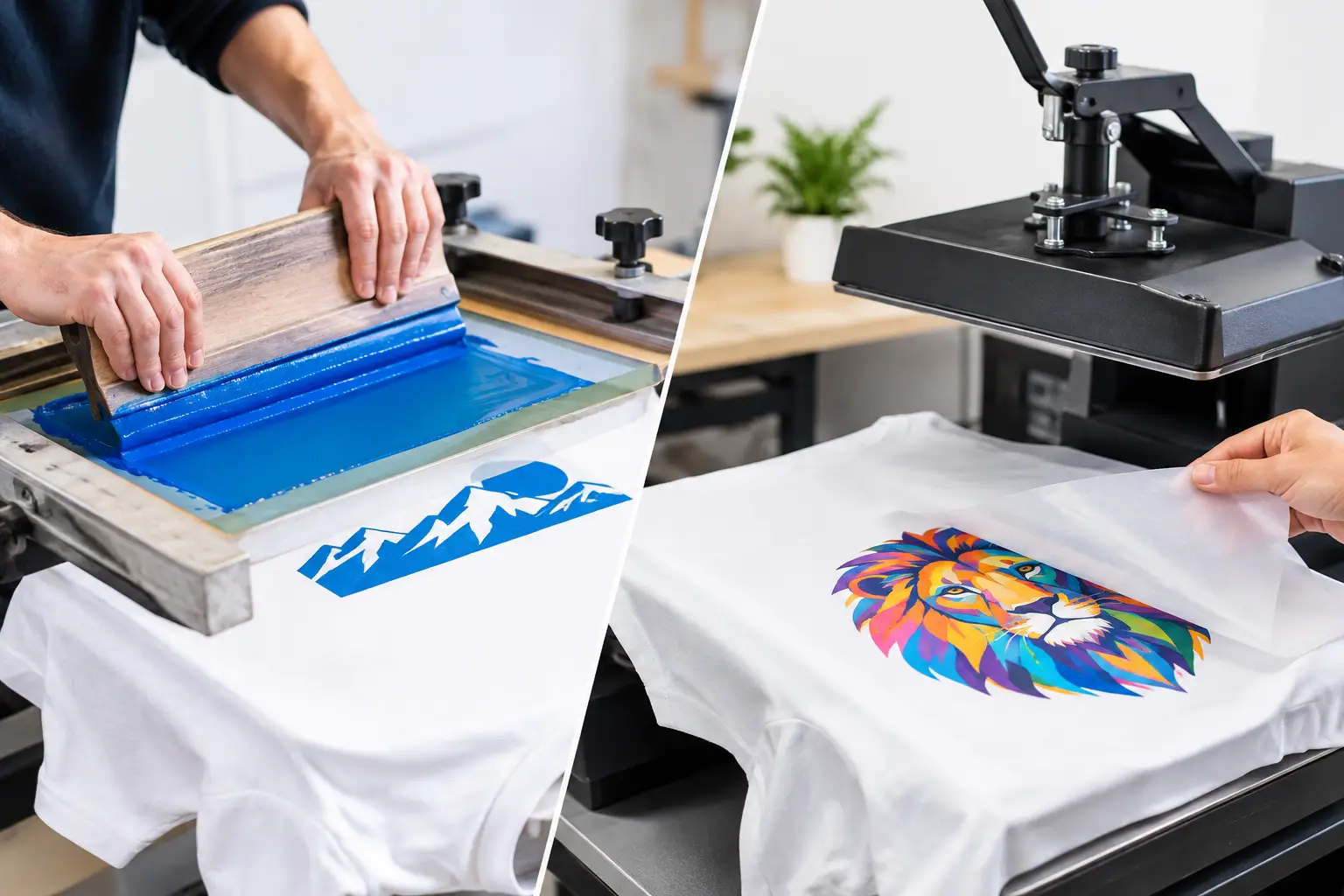
A team jersey, work uniform, or promotional garment needs to stay legible through washes, practices, and workdays. Between screen printing and heat transfer, the right choice depends less on general preference than on the design to reproduce, the fabric, the quantity, and the actual use of the garment. A simple logo intended for 200 t-shirts doesn't come with the same constraints as an individual name on 25 jackets.
For schools, sports leagues, businesses, municipalities, and event organizers, understanding this difference helps in ordering decoration that is consistent, durable, and suited to the budget. Both methods deliver excellent results when chosen for the right application.
Screen Printing or Heat Transfer: The Basic Difference
Screen printing involves applying ink directly onto the garment using screens prepared according to the colours of the design. Each colour is printed separately, then the ink is dried or heat-cured. The result becomes an integral part of the textile surface, with a finish that is generally very stable for logos, lettering, and solid colour fills.
Heat transfer, on the other hand, is first produced on an intermediate substrate, then applied to the garment using a heat press. Depending on the technology used, this may involve cut vinyl, a printed transfer, or a process that allows detailed images to be reproduced. The design is then pressed onto the designated area, piece by piece.
This distinction has real practical consequences. Screen printing requires more upfront preparation, but becomes very efficient for a run of identical garments. Transfer offers great flexibility for small quantities, individual customization, and complex visuals.
When Screen Printing Is the Better Choice
Screen printing is particularly well-suited when the same logo needs to appear on a large quantity of garments. A company ordering t-shirts for its seasonal staff, an association preparing jerseys for a race, or a school outfitting several groups will typically get an excellent balance of quality, consistency, and cost per unit.
It works very well for designs made up of solid colours, crisp text, and well-defined shapes. On cotton, cotton-polyester blends, or many common promotional garments, the ink delivers a strong visual presence. Colours can be vibrant and opaque, including on dark fabrics when the preparation is done properly.
Durability is one of its main advantages. With ink and curing suited to the textile, screen-printed decoration holds up well through regular use and repeated washing. It is a reassuring option for uniforms, workwear, sports teams, and items that will be worn on a regular basis.
The main limitation lies in setup. Each additional colour may require separate preparation. A two-colour logo is therefore simpler to produce than an illustration featuring multiple shades, gradients, and photographic detail. For a small order of just a few pieces, these setup costs can make screen printing less advantageous.
Projects That Are a Good Fit
Screen printing often meets the needs of team jerseys, event t-shirts, corporate polos, volunteer clothing and promotional items distributed in large quantities. It is also well suited when the same brand colours need to be reproduced consistently across multiple sizes and multiple runs.
Before production, however, the colour of the fabric, the fibre type and the placement of the logo must be verified. A highly detailed design printed at a small size will not necessarily look the same as a flat-colour logo. A well-prepared mock-up prevents surprises and makes for a clean print.
The strengths of heat transfer
Heat transfer is a practical solution when each garment needs to be different. A number on the back, a name on the chest, a job title, a limited run or a visual with multiple colours can all be produced without preparing a screen for each variation.
For a sports team, for example, the common logo can be applied to all jerseys while names and numbers vary from one player to the next. For a business, it is possible to mark a few jackets with employee names or to add identification to workwear that has already been selected. This flexibility is hard to match on very short runs.
Heat transfer also makes it possible to reproduce visuals rich in detail, including certain multicolour illustrations, textures and images that would be more complex with traditional screen printing. This is an advantage for promotional campaigns, commemorative garments or designs whose artwork goes beyond a simple logo.
The final look varies depending on the type of transfer and the fabric. Some transfers produce a very soft finish, while others have a slightly more noticeable feel than screen-printed ink. This is not necessarily a drawback: on a sports number or personalized lettering, that finish may be exactly what is called for.
Limitations to keep in mind
A transfer must be applied with the right pressure, temperature and press time for the fabric. On technical, stretch or treated textiles, the choice of transfer material matters a great deal. A poor combination can affect adhesion, flexibility or durability after washing.
The size of the design must also be considered. A large transfer applied over a wide area can reduce the breathability of a lightweight garment. For a sports jersey worn during physical activity, a smaller or strategically placed decoration may be preferable. The garment and its intended use should guide the decision, not just the appearance of the mock-up.
Order volume genuinely changes the decision
Volume is often the deciding factor. For a few personalized t-shirts, uniforms with individual names or team gifts, heat transfer is often the most straightforward option. It accommodates variations and avoids committing to significant setup costs for a limited number of pieces.
When an order involves several dozen or hundreds of identical garments, screen printing generally becomes the more practical choice. The upfront setup cost is spread across the full run, and the print can be reproduced with a high degree of consistency. It is therefore particularly well suited to annual campaigns, tournaments, community events and employee programs.
It is not uncommon for a project to combine both methods. An organization's logo may be screen printed on all garments, while names, titles or numbers are added by transfer. This approach keeps a durable primary mark in place while still meeting individual identification needs.
Fabric, colour and intended use must be considered together
A cotton t-shirt, a blended polo, a polyester athletic sweater and a work jacket do not all respond the same way to ink or heat. Some polyesters, for instance, may require inks or transfers specifically formulated to limit colour migration. Stretch fabrics also call for a decoration method that moves with the material without cracking prematurely.
The colour of the garment matters just as much as its composition. A light logo on a dark textile may require an underbase or special treatment to maintain its opacity. Conversely, a dark design on a light garment is generally more straightforward to produce. Fine details must also be scaled to the final decoration size to ensure that text remains legible.
Intended use rounds out the assessment. T-shirts handed out at a one-time event do not carry the same requirements as uniforms washed every week. For workwear, durability, visibility and ease of care often take priority over reproducing a highly detailed graphic. For a colourful promotional item, graphic accuracy may become the primary concern.
Preparing an order without any unpleasant surprises
Before requesting a quote, it helps to gather the garment count, sizes, colours, fabric type, decoration placement and desired date. You should also provide the logo in the best available format and specify whether files, names or numbers vary from one piece to the next.
A mock-up makes it possible to confirm the visual's size, positioning and the legibility of the information. This is especially important for team names, sponsors, job titles and logos containing small text. A correction made before production is always easier to handle than a change requested after printing.
At Mr. Trophy, the right decoration method can be assessed with the garment, the artwork and the goal of the order in mind. This approach works equally well for a run of uniforms, event sweaters, promotional apparel or branded items for an organization.
The best decoration is the one that suits the reality of the project: consistent screen printing for a large run, flexible transfers for personalized pieces, or a combination of both when a logo and individual identification need to coexist. By clarifying the intended use, the quantity and the desired outcome from the start, you give the production team everything it needs to propose a solution that will look just as good at handout as it does after many washes.
You may also like
Screen Printing vs. Digital Printing: Which One Should You Choose?
Screen printing vs. digital printing: choose the right technique for your apparel, signs and promotional items for a durable, precise result.
UV vs. Screen Printing: Which Marking Method Should You Choose?
UV vs. screen printing: compare precision, colours, durability and costs to choose the right marking method for your trophies, items and professional signage.
Magnetic Plaques or Stickers: Which Should You Choose?
Magnetic plates or stickers: compare hold, application, reusability and finish to choose the right signage for each professional use.