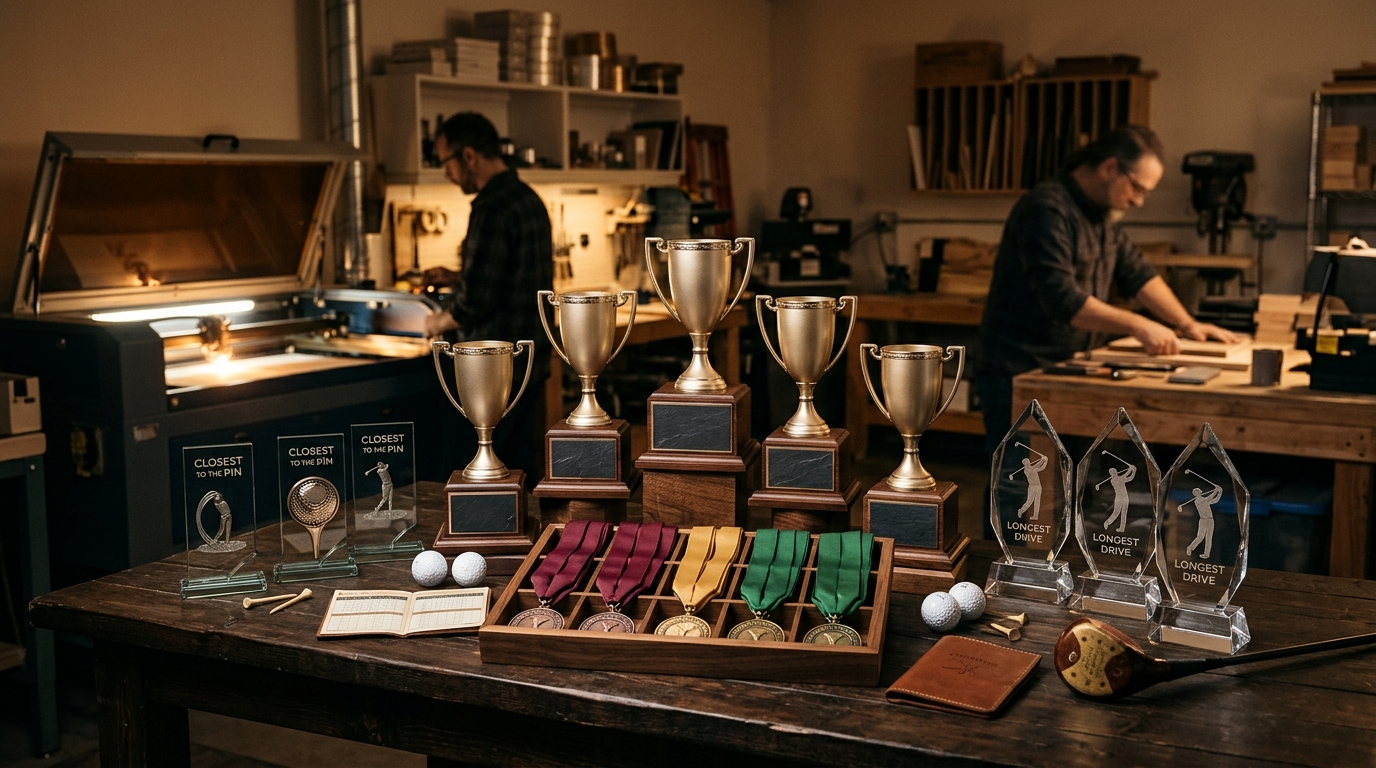
A charity scramble can have one winning team and still leave plenty of players out of the awards. Champion, flight winners, closest-to-pin, and longest drive each tell a different story, and each needs a different award format and quantity. If you order golf tournament trophies before you understand your field size, flight structure, and contest holes, you risk shortfalls in some categories and leftovers in others.
This tutorial is for beginners who want a clear path from tournament format to prize table. It starts with why one trophy is not enough for a charity scramble, then explains what a flight actually means in scramble play. From there, you will define flights from your field size, count winners per flight including ties, and assign a format to each award role. You will also learn how champion and flight winner awards differ from closest-to-pin and longest drive awards. Finally, you will build a prize table before you order, choose trophy formats, engraving and finish, review a worked prize table for a mid-size field, and take your next steps before ordering.
Why One Trophy Is Not Enough for a Charity Scramble
A scramble crowns several winners at once: an overall champion team, a flight winner per flight, and individual skill-contest prizes for closest to pin and longest drive. Each role carries its own format, quantity and engraving needs.
Ordering a single generic cup and improvising the rest on event day is the most common first-year mistake. Flight winners are left with nothing to hold up, the moment sponsors and donors notice most.
The reverse error costs as much: buying equal sets of everything produces leftovers when the field is smaller than expected or the flight count changes after registration closes.
The fix is a short planning pass before any order: define flights, count winners per flight, assign a format to each award role, build the prize table, then order to that table.
This guide is for organizers who know golf but not award logistics: volunteer committees, association staff and municipal recreation coordinators running a first or second charity scramble. The sections that follow walk through each planning step in order.
Scramble Format and What a Flight Actually Means
In a scramble, every player hits, the team plays the best ball, and one team score is recorded per hole. With no individual score, every prize is a team prize or a hole-contest prize.
That is why a scramble needs flights: one low-handicap foursome can run away with the event, leaving the rest of a 30-team field with little reason to stay engaged.
A flight is a group of teams competing only against each other. Common practice sets flights three ways: by combined team handicap, by qualifying team score, or by division such as men, women, mixed, senior or junior.
Flight count generally follows field size. A 12-to-18-team field often runs two flights, a 25-to-36-team field commonly runs three, and larger charity fields sometimes use four or more. Treat these as working starting points, not fixed rules.
Confirm governance rather than assuming it. Whether the Rules of Golf, Golf Canada or your host club's local rules govern contest prizes and handicap use is for your tournament committee or host professional to verify; the committee sets the format, handicap allowance and tie-breaking terms, as outlined in the R&A's guidance on terms set before competition begins.
Step 1: Define Your Flights From Your Field Size
Now that flights are understood as groupings, lock the plan to a realistic team count. Use last year's paid entries, current registrations and a conservative growth estimate rather than the maximum your course could host.
Decide the flighting method before printing anything. Handicap-based flights require verified handicaps at registration, since a Handicap Index depends on club membership and submitted rounds. Score-based flights can be set after the first round or a qualifying nine. Division-based flights are easiest for a beginner committee to run and explain.
Choose labels that engrave cleanly. Division names (Men's A, Mixed B, Senior) and simple letter tiers beat long descriptive phrases on a plate.
Write the flight structure into your published rules of competition. A formal rules document is standard practice for charity scrambles and gives you a defensible answer when a team questions its placement.
Finally, flag the in-between scenario. If registration lands between two flight counts, decide in advance whether you will expand to four flights or merge into two. That decision prevents an emergency re-order in the week before the event.
Step 2: Count Winners per Flight, Including Ties
With flights set, the count is simple. Standard practice is one winning team per flight, so total flights equals total flight trophies. Confirm this with your committee before ordering, since some events also recognize a runner-up per flight.
Ties are the quantity trap. A scramble records one team score per hole, so mid-flight ties are common. Decide now whether tied teams share one award, each receive individual pieces, or play off for the trophy. Tie methods belong in the terms of competition, set before play begins.
If tied teams share, order one extra flight trophy as a buffer. If each receives a piece, the buffer must be larger and engraving flexible enough to add a team name late.
Count at team level and player level separately. A flight trophy is usually one piece per team; medals or keepsakes scale with four players per team.
Build a written count sheet: flights, winners per flight, teams per flight, players per flight. That sheet becomes your order quantity and your defence against questions about the spend.
Assigning a Format to Each Award Role
The count sheet sets quantities; format is a separate decision. The four roles, champion, flight winner, closest to pin and longest drive, are not interchangeable, because each has a different audience, presentation moment, and therefore a different size, format and finish.
The champion award carries the most visibility and sponsor association, so it justifies the largest piece and the fullest engraving: event name, year, flight, team names and the beneficiary or cause.
Flight awards should echo it in a matching format but sit clearly one tier down, so the hierarchy reads instantly when all winners stand together for photos.
Skill-contest awards go to individuals, are announced on the course or at the banquet, and work best as smaller keepsakes that photograph well in one hand.
Settle this list before requesting pricing. Defined roles, quantities and sizes turn a vague enquiry into a quotable order, whether you compare suppliers or source custom trophies locally.
Champion and Flight Winner Awards
With formats settled, two team awards anchor your set: champion and flight winners.
The overall champion receives one team award per event, usually the largest piece you order. Engrave the event name, year, team name and player names. Many clubs retain this piece and rotate it among past winners, so confirm whether yours stays with the winning team or returns to the club.
Flight winners receive one team award per flight in a matching but smaller format. Make the flight designation legible from a few metres away; the label makes the hierarchy obvious in group photos.
Runner-up recognition per flight, if your committee wants it, is a low-cost credibility upgrade. It doubles the teams leaving with something for a small increase in quantity.
Team names need one clear convention. Ask each team to submit an official name at registration so a plate is never engraved twice because a captain shortened it on the scorecard. Assume rosters change: lay out plates with the team name prominent and player names on a smaller line, so a late substitution does not spoil a finished award.
Closest to Pin and Longest Drive Awards
Team awards are settled; skill contests need their own count. Closest to pin normally takes one award per designated par 3. Designate four par 3s and you need four awards, plus a decision on whether men, women or all players compete on the same marker. Longest drive usually takes one award per designated hole and often one per division. Two long-drive holes run separately for men and women means four awards, not one.
Judge and mark every contest hole before the first tee time. A visible marker, a tape measure and a printed card at each hole keep a skill contest from becoming a banquet dispute.
Because these prizes go to individuals, size matters more than prestige. A keepsake that fits in one hand, engraved with the hole number and event name, is the practical choice.
Total skill-contest quantity follows designated holes multiplied by divisions and categories. Write that multiplication out explicitly on the count sheet: it is the line item most often under-ordered.
Step 4: Build the Prize Table Before You Order
With skill-contest quantities settled, the last planning step is a single grid: the prize table. List every award role in rows and, across the columns, quantity, format, size, engraving content and presentation timing. It is not administration for its own sake. It is the only reliable way to match an order to your tournament format.
Fill it in the order the decisions were made: flight awards first, since flight count drives quantity; then skill contests, holes multiplied by divisions; then the single champion piece.
Total the grid twice, at team level and at individual level. A hypothetical field of 28 teams in three flights, with two long-drive holes and four closest-to-pin holes, orders far more individual keepsakes than the same field running one contest hole of each type.
Add one buffer line, in the category most likely to tie or grow. Blank pieces can be engraved later; a missing award on event day cannot.
Then send the completed table to your supplier as your request document for custom trophies. A completed table earns a more accurate quote and lead time on the first attempt.
Step 5: Choose Trophy Formats, Engraving and Finish
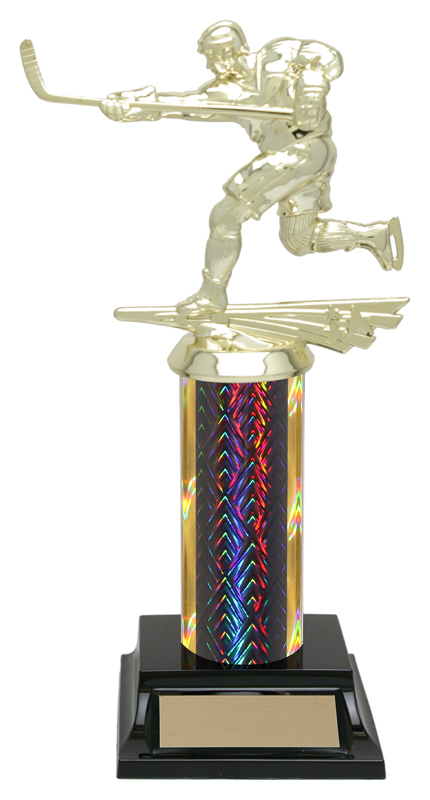
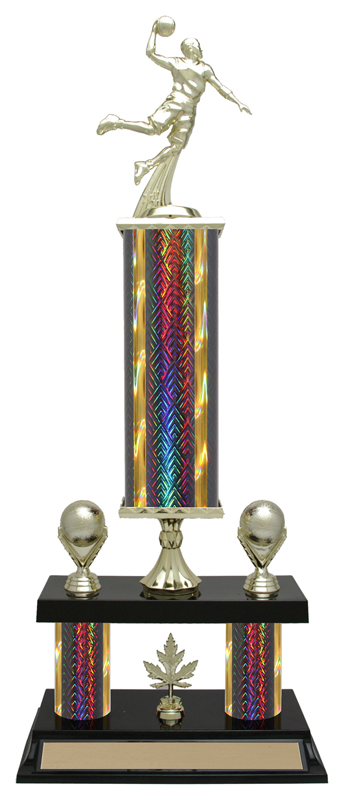
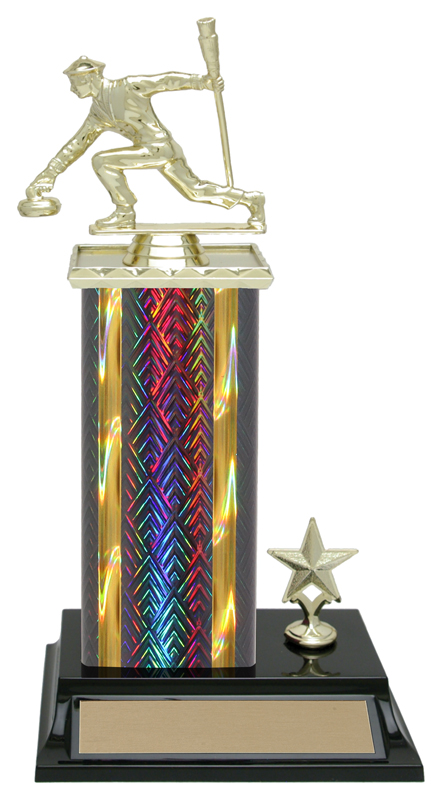
With your prize table in hand, translate each line into a format. Cups, columns and plaques read as team awards; medals and smaller keepsakes read as individual contest prizes or player souvenirs. Hierarchy matters more than any single material choice: the champion piece should be visibly the largest, flight awards next, skill-contest keepsakes smallest and most portable.
Settle engraving content while the count sheet is still open. Event name, year, flight or contest hole, and team or player name: fixing these fields in advance is what keeps a laser-engraved plate from being redone. Colour printing suits a sponsor logo or charity brand that must reproduce accurately, while a single-colour engraved line is usually cleaner for team names and years.
Mr Trophée is a Léry, Quebec workshop serving sports teams, businesses, municipalities and organizations. Its personalized trophies and medals, plaques, engravings and honorary awards use laser engraving and colour printing, backed by bilingual service and a best-price guarantee. Review finished award projects or explore the workshop's services to see how a flighted set looks assembled. Call 514-565-6665 to confirm quantities and lead times once your prize table is complete.
A Worked Prize Table for a Mid-Size Field
With formats and engraving content fixed, the final planning step is totalling the order. This table is an illustrative example only, not a documented event or a reported outcome.
Assume 28 teams of four, three flights, one champion award, one closest-to-pin prize on each of four par 3 holes, and two designated long-drive holes contested separately by men and women.
Team awards: one champion piece plus three flight winner pieces, and optionally three runner-up pieces if your committee recognizes second place. That is four to seven team-level trophies.
Skill contests: four closest-to-pin keepsakes plus four longest-drive keepsakes, since two holes run for men and women separately. Eight individual pieces in total.
Player keepsakes are a separate decision. If every participant receives something, the count is 112 pieces across 28 teams. This line item most often blows a trophy budget, so choose it deliberately rather than by default.
Add a buffer: one extra flight award and one extra skill-contest keepsake, left unengraved until winners are confirmed. Excluding player keepsakes, this event needs 14 to 17 pieces.
Your Next Steps Before You Order
Before requesting a quote, confirm two things with your committee or host club: how flights will be set (handicap, score or division) and whether local rules of competition specify anything for contest prizes. Verify charity, tax and prize-value questions with your accountant.
Then finalize the grid: flights, winners per flight, contest holes multiplied by divisions, keepsakes, and one buffer in the category most likely to tie or grow. Bring it to a supplier for quantities, engraving and lead times. Mr Trophée in Léry, Quebec handles personalized trophies, medals, plaques, engravings and honorary awards with laser engraving and colour printing, offers bilingual service and a best-price guarantee: 514-565-6665. See Nos 21 services and about the workshop.
Conclusion
A strong flighted awards set starts with your field size. Define flights first, then count winners per flight, including ties, so your prize table matches the format. Build the full grid before ordering: flight awards, skill contests, player keepsakes, and a buffer in the category most likely to grow. Treat participant keepsakes as a deliberate budget choice, not an automatic add-on. Once your committee confirms flights and local rules, finalize quantities, engraving, and lead times with a supplier. Mr Trophée in Léry, Quebec offers personalized trophies, medals, plaques, engravings, honorary awards, laser engraving, colour printing, bilingual service, and a best-price guarantee at 514-565-6665. Then place your order with confidence. Your scramble will reward every flight fairly and leave your charity with a finish worth celebrating.
À lire aussi
Prix méritas scolaires : le guide pour bien récompenser vos élèves
Gala méritas, remise de fin d'année ou bourses d'excellence : voici comment choisir les trophées, médailles et plaques qui soulignent vraiment la réussite de vos élèves.

Avis broderie professionnelle pour vos équipes
Un avis broderie professionnelle utile : qualité du fil, tenue au lavage, choix des vêtements, logo, délais et contrôle avant production pour vos équipes.
Trophées et médailles pour un tournoi de baseball ou de balle-molle : le guide des organisateurs
Catégories, quantités, prix individuels et personnalisation : voici comment bien récompenser les équipes de votre tournoi de baseball ou de balle-molle, de la planification à la remise.